
Aesthetics

Are You ‘A Creative’?

When I started thinking about this post, I imagined it was going to be a critique of a rather irritating article I had seen about ‘things that creatives do differently’. And I’m still irritated by it, to the extent that I’m not going to give it the compliment of linking to it. It was full of contradictory statements: creatives like to daydream, creatives are very observant; creatives like solitude, creatives like to seek out new experiences. They don’t do all of those at the same time, though, do they? If you’re day-dreaming, you’re not noticing what’s about you; if you’re alone and quiet, you’re not seeking out new experiences.

So if the idea was to learn from ‘creatives’ how to be more like them, it was no help at all. And really, I didn’t see what was so very ‘different’ about most of them. Most of the statements you could replace the word ‘creatives’ with ‘people’ and they would still ring true. I’m sure the research they were reporting on did genuinely find creative people doing all these things, but I’m not sure that tells us very much about creativity.

The Arranger's Super-Ego

I don't know quite why I started thinking in Freudian terms recently about arranging. I am sceptical in all kind of ways about Freud's theories - so many of them are so phallocentric, after all, which may feel normal for men, but just looks weird from a female perspective. But there are also ways in which he was quite humane and you can't accuse him of having not spent enough time thinking about this stuff.

Anyway, the experience that brought all this to mind was the stage of arranging I think of as 'combing' - getting all the lines lying smoothly so there aren't any tangles in the music to bump the listener, or knots in the lines to impede the singers. And I got to reflecting on how I know when an arrangement is finished.

On Artistic Freedom

On the same day I was having my revelations about feeling under the artistic thumb of over-interfering editors, a colleague/friend posted this on his Facebook timeline:

How can I put this without seeming unkind?. Putting aside my own paltry efforts in this field it was my misfortune to attend the worst piano recital today I've heard in 55 or so years of concert going; playing which would make Cherkassky and Pogorelich seem models of pianistic rectitude. Half a dozen or so (lost count) Chopin Nocturnes followed by Prokofiev's mighty 8th Sonata - a consummate display of pianistic and musical incompetence, the id always to the fore, the music merely a vehicle for a display of a grotesque psychotic disorder. Inner voices ('look how smart I am') which go nowhere except up cul-de-sacs, a musical narrative nowhere to be seen or understood; special 'effects' by the bucket load. And all accompanied by penetrating glances into the audience just to check how 'appreciative' we were of his extraordinary individuality.

It struck me that this is about as clear an argument as I’ve ever seen against the concept of ‘artistic freedom’.

On Editorial Oppression

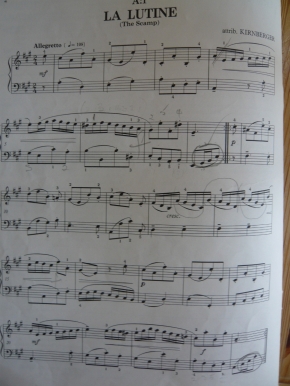
Another page from my childhood repertoireAnother page from my childhood repertoireWhen I was looking back at my childhood piano music last month, it wasn’t just the admonitory annotations that leapt out at me. I also found myself quite boggled to see quite how much editorial stuff had been added to the older pieces. Articulation, phrasing, dynamics, all kinds of stuff in profusion. I had forgotten that music used to look like this.

And you know what? I felt really boxed in by all those extraneous instructions. It was almost hard to read the notes for all the lines and dots and other paramusical paraphernalia. I hadn’t noticed how accustomed I have become to modern editorial habits that aim to strip out all the accretions of time and get back as close as possible to the text the composer produced (and to provide footnotes to tell you where the editor is having to make a guess).

Legato - Vocal or Musical?

smoothI first encountered the concept of legato as a young pianist. Which is of course, the least literal medium to engage with it. Every note a pianist plays immediately starts to die; there is no way actually to join the sound up into a line. So legato as a concept was glossed as ‘smooth’ rather than the literal ‘linked’ or ‘joined-up’ of the Italian term, and was achieved by a sleight of hand by which you manage the attacks and releases of notes to create the illusion of continuity.

So when I met ‘legato’ as a concept in singing, I was used to it as an essentially musical, even metaphorical concept. It came as something of a surprise, therefore, to discover how it operates in singing as a central element of technique. ‘Line’ is something that is achieved through a consistency of airflow, placement, and vowel shape.

Am I Musical?

question markThe term 'musical' is one that puzzles me greatly. You might think that someone in my line of work would know what it means, but in fact I see it being used in multiple different ways. Some of these I find at least moderately problematic, especially when they get muddled up with other uses.

(Indeed, when I was involved in writing course documentation for degrees in performance and composition, we avoided the word 'musicality' in favour of 'musicianship' for precisely this reason. There's enough anxiety around assessment criteria without loading the terms.)

The term gets used in (at least) three different ways.

On Avoiding Hack

I'm writing this post while in the middle of arranging a song destined to be part of a barbershop contest package. So I am thinking very specifically about the craft of producing contest-grade barbershop, though I suspect I may find myself ranging more widely by the time I'm done. It is very much writing-to-figure-out-exactly-what-this-thought-I-am-trying-to-have mode, so I may ramble. You have been warned.

(Of course, if the thought ends up being especially trite, I have the option of never posting it. Though I might enjoy the irony of engaging in deep thought to come up with a truism. That in itself might say something about the subject.)

So, 'hack' is the phrase used in stand-up comedy for material on themes that are over-used. It is an insult that includes both lack of creativity (you couldn't think of anything original to say) and laziness (you came up with the most obvious joke, then stopped working). The term is, I imagine, derived from 'hackneyed' in the more general sense, as tired and clichéd, but there is a specificity to its usage in comedy that I find interesting.

Sound, Vision and Musical Judgement

There’s been a certain amount of heat coming from under collars in the musical world over the last few days over reports of research that showed that judges in piano competitions appear to be using visual information more than aural in picking winners.

Or, to be more precise, people asked to second-guess judges in piano competitions got the same answers much more reliably by watching silent videos than by either audio alone or video+audio clips. Which isn’t precisely the same thing, but the research sounds like it is robustly enough constructed that one can reasonably draw that conclusion.

Now, the heat has come in the rather predictable form of fulminations about:

  • Young performers getting promoted on glamour rather than ability
  • How shallow and dumbed down everything is getting with all this focus on visual things instead of the Music Itself
  • How nobody ever listens properly any more

Which is interesting in all kinds of ways, not least that all these points, except possibly the last one, are at best tangential if not completely irrelevant to the research. But they do help reveal why the research is proving so disturbing.

...found this helpful?

I provide this content free of charge, because I like to be helpful. If you have found it useful, you may wish to make a donation to the causes I support to say thank you.


Archive by date

Syndicate content Syndicate content