
Aesthetics

Riding the Wave of Melody

wave

When I was writing up my visit to The Royal Harmonics back in August, an image that has long lurked in the back of my mind came into much more vivid focus: the idea of musical flow as water. The specific image that opened this image up was the association of the swell of melody with depth of feeling.

A melody that is sung note-to-note-to-note is somehow like a shallow puddle, with little wavelets little more than ripples. The peaks of the ripples are all the same height, and that height is only minimally above the surface of the water: they lap at the edge of the pool with no great effect. The ripples are also close together. So if you want your love-song to sound as shallow as a puddle, you should energise each note individually, but just by a bit, and not make much differentiation one from another.

Extreme Quartetting

I spent Saturday afternoon and evening in Nottingham at the British Association of Barbershop Singers’ Harmony College, at which I had been invited to judge the contest that formed part of a stream called ‘Extreme Quartets’. This is a model that takes the idea of chamber music as practice gadget, and simultaneously supports and intensifies the experience.

The way it works is this. Participants learn a great pile of music in advance (in this case, six songs), and then spend the weekend receiving coaching on them, both as a chorus – re-living the original invention of the barbershop chorus as a way to deliver coaching to lots of singers simultaneously – and in a variety of quartet line-ups. The contest had a preliminary round in the afternoon, with the top two quartets and a randomly-picked third going through to the final in the Saturday evening show.

Rehearsing, Performing and the Relationship with Time

timeparadoxI recently found myself leafing through a book called The Time Paradox that explores the question of people’s relationships with past, present and future. These relationships seem to consist of a combination of attention (is your imagination always leaping ahead to plans and projects yet to come, or wallowing in events that have already happened?), and emotional orientation (do you focus on the positive or negative aspects of the time you’re paying attention to?).

Lots of interesting stuff in there, of which possibly the most important for practical purposes is the typical profile of happy and well-adjusted people. This involves a strong orientation towards the positive past (traditions, happy memories, as opposed to regrets), and a reasonably strong orientation to both the hedonistic present (pleasure, living in the moment, as opposed to the fatalistic present in which you feel no control over your life) and to the future. They also have some useful lists of things to do to strengthen your connection with any of these if you’re out of balance.

Classical Girl Power?

In the Diamond Jubilee concert at the Llangollen International Musical Eisteddfod, Lesley Garrett introduced the line-up of herself, violinist Nicola Benedetti, trumpeter Alison Balsom and conductor Sian Edwards as ‘classical girl power’. I found myself simultaneously cheered at this list of soloists and wistful that it should still be a matter of remark. ‘Girl Power’ is after all one of those odd phrases that encapsulates optimism and defeatism at the same time.

However, the concert was a very interesting case-study in different solutions to the presentational questions female musicians need to address in their roles as public figures. As I have written about before, there are competing imperatives between the ideologies of classical music that render the musician invisible to ‘let the music speak for itself’ and the general cultural expectation that the female body will be on display, subject to public gaze.

Singing and Dancing in the Rain

The main stage and its superabundance of flowersThe main stage and its superabundance of flowers

Actually, there were some patches of glorious sunshine during last week's Llangollen International Musical Eisteddfod, but these were sandwiched in between days of persistent rain, punctuated by some impressive thunderstorms. The River Dee was transformed from its usual summer guise of sparkling backdrop for photo-calls into a raging torrent, and the guys selling wellies and brollies up on the Eisteddfod Field were doing very good business indeed.

But the people who had travelled from around the world continued undaunted.

Scoring Artistic Quality: the Meaning of Numbers

I recently received an email asking if I might like to write about the experience of being an adjudicator - which of itself is quite a broad topic, and one on which I have wandered across occasionally in previous posts. The email then homed in on a much more specific kind of question, as follows:

What I'm particularly interested in is the fact that in my experiences, it seems to be really difficult for a chorus at music festivals get less than 75%, no matter how bad they are, and the difference between results for barbershop choruses in a festival may be just 5%, but when that is transferred to a barbershop competition, the spread is 30% +, which means that you then have to try to explain to the chorus why they can do so well in a general festival compared to a barbershop comp.

Now, this is one of those questions that has what at first looks like a simple answer, but when you live with it for a while, you see that the simple answer contains within it a rather more interesting point.

Participation, Performance and Musical Standards

Recently I was having a facebook chat with a friend who wanted to talk over a dilemma, and it occurred to me that it was worth sharing, as it has at its heart what is probably the biggest question community arts face. The dilemma is this: he is the director of a village band which has an active committee that succeeds in getting them lots of paid gigs. However, it is an open-access band, and many of the players are not very skilled. He was therefore worried whether it is right to accept money for these gigs when the artistic product is often shaky at best.

Isn’t this an interesting question?

Jimbob’s Pictures of Musical Processes

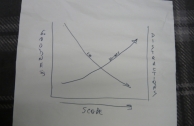
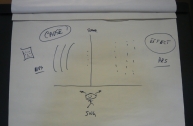
jimbob1jimbob2


Earlier this month, BABS and LABBS held their triennial joint re-certification school, at which judges from both organisations are required to formally qualify in order to continue their service. This undertaken with the help of visiting judges in each category from the Barbershop Harmony Society, who play a role both in leading training and overseeing the assessments.

The Music Category was delighted to welcome current Category Specialist Jim Kahlke, who as well as all the usual virtues you see in people who take on this mantle, has a happy knack for drawing pictures of ideas. So I thought I’d share a couple of them that have resonance beyond the specificities of barbershop judging. I’m pretty sure that both sets of ideas were attributed to other members of the category (Roger Payne and Kathy Greason respectively, if I recall), but I’m calling them Jimbob’s here because it’s his drawings we’re looking at.

...found this helpful?

I provide this content free of charge, because I like to be helpful. If you have found it useful, you may wish to make a donation to the causes I support to say thank you.


Archive by date

Syndicate content Syndicate content