
Aesthetics

BABS Convention 2010

HIC's integrated social spaceHIC's integrated social space

The last weekend in May saw Britain’s barbershoppers return to one of their favourite venues for this year’s BABS Convention. The Harrogate International Centre provides not only a good-sized auditorium and enough ancillary rooms for changing and warm-ups for 37 choruses, but a wonderful central space for the social interactions that fit in an around the formal events of contest and shows. The continuity of space from area to area and level to level allows everyone to feel they are part of the same occasion, while the way the space is broken up into somewhat separately defined areas gives a sense of cosiness and intimacy.

The convention had enjoyed considerable publicity beforehand, including an article in the Independent on Sunday the previous week, which rather confusingly presented a picture of the quartet The Cardinals from 1949 as an illustration for a feature on 2008 BABS champions Monkey Magic. It also gave a nice example of how the journalistic research process is well-suited to perpetuating errors and misunderstandings; I’m sure any of their interviewees would have been happy to put the writer right on their assertion that ‘when entering competitions members are restricted to performing a list of traditional songs’.

Gesture and Song

I’ve written before – both here in my blog and at length in my choral conducting book – about the ideas of David McNeill on speech-accompanying gesture (pdf), and how they can help us understand conducting. But I also find them interesting from the perspective of the singer in performance. Whether and how much to gesture is dilemma that singers routinely face: too much hand movement can be distracting, while keeping the hands completely still can seem unexpressive.

Arranging as Playing Cat’s Cradle

The thing that makes cat’s cradle work is the balance of opposing forces. The threads can form a structure because they are held in tension by the separated hands. Bring your hands together and this tension is released, and the three-dimensional form collapses.

I find this a useful image for juggling the competing demands a song makes on the arranger. There’s a network of opposing forces in somewhat different dimensions, both technical and artistic, pulling on the arrangement as it develops. Depending on the song and the group who’s commissioned it, the demands will vary, but there will always be this sense of simultaneous, but conflicting imperatives.

Successful Singing Secrets

successfulspeakingOn Tuesday I participated in a teleseminar on Chris Davidson’s book Successful Speaking Secrets Quick Reference, which was published at the end of last year. Chris became a full-time public speaker and speaking coach about 8 years ago, when he could no longer bear the dire quality of most of the presentations he had been witnessing in industry. He has made it his life’s mission to inveigle business leaders of the world into becoming interesting to listen to.

I had a direct interest in the subject as a presenter (and one with opinions, indeed). But I also found myself applying his ideas to the roles of the musical performer and the conductor as we went through. After all, being interesting to listen to is a useful quality for a musician to have, too. My impressions are a little miscellaneous as yet – this post is about rummaging through the plethora of things that caught my attention, but I think there are also a couple of Big Ideas that may emerge as posts in their own right when I’ve had time to live with them for a while.

Art & Education

I was recently asked to write a reference for a barbershop chorus that was applying for charitable status, in response to the following question they had been asked:

Please provide independent expert evidence to show the performances are of sufficient educational merit to raise aesthetic taste.

As it happens, it’s quite a good chorus, so I could happily write in their support, and it’s quite easy to point to reasonably objective level indicators with barbershop, because the contest system is so effectively standardised internationally. The criteria are so explicit and the training regimens so thorough, that you can look at a collection of scores and articulate in some detail what they say about performance quality.

But what I found interesting was the set of assumptions built into the question.

Musical Unity and Musical Vision

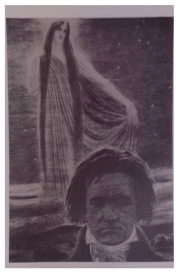
The Romantic idealThe Romantic idealOne of the aesthetic truisms that I absorbed during my undergraduate education, and have spent the subsequent years questioning,* is that great music has the quality of unity. This was purported to arrive in the music as the unconscious result of the composer’s genius, but could be uncovered via technical analysis. There were different dimensions in which you could identify this unity, Schenkerian tonal coherence and more or less hidden motivic connection in the manner of Réti being chief among them.

Even as a student, I was faintly perplexed by the equation of a spiritual attribute with concrete, technical details. I had a composer friend who was deeply taken by this aesthetic, and I used to ask him why, if the point about unity in great music was that it was created unconsciously, did he spend so much conscious effort constructing the motivic structure of his music? (He, on the other hand, felt I wasn’t taking our art sufficiently seriously when I upheld a valid role for whim in the compositional process.)

Performance Style in the Age of Recordings

One of the main interpretive challenges to face classical musicians is the ambiguity of notation. The dots on the page are very informative about what to play, but mostly leave us guessing about how. What looks like the ‘same’ notation will carry different expectations for performance style at different points in history and in different places. Formal training teaches the typical answers to these questions, and advanced training provides the research skills to seek out mores specific answers for particular repertories.

Of course, even armed with all the available information – about historical instruments, and the techniques used to play them, about the treatises on performance or aesthetics – the musician still has the imaginative task of converting that into real sounds. An interpretation thus represents a statement of how the performer concludes the music should go.

Now, for people working with popular repertories of the last 50 years or so, the task is very different, since the definitive text is now no longer on paper, but a recording.

How much do we know what we’re doing?

John Mayer: music as intellectJohn Mayer: music as intellectAndrew Downes: music as feelingAndrew Downes: music as feeling

At one point we had a pair of composition teachers at Birmingham Conservatoire who seemed to get on very well, but nonetheless had diametrically opposed views about how we should approach music. John Mayer used to harangue me over the photocopier about how music was nothing to do with the heart, but was an intellectual pursuit, while the then Head of Composition and Creative Studies, Andrew Downes used to say that you should never analyse anything, it should all come from the heart.

...found this helpful?

I provide this content free of charge, because I like to be helpful. If you have found it useful, you may wish to make a donation to the causes I support to say thank you.


Archive by date

Syndicate content Syndicate content