Excellence

On Expressive Gesture: Introduction

exprgesture

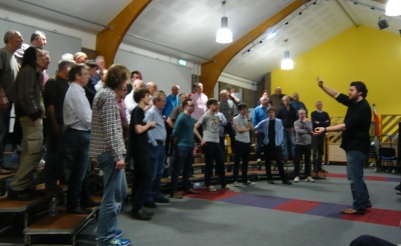
How can a conductor learn to communicate more expressively with their gestures? The temptation when we first ask this question is to focus on what we’re doing with our hands, but I’m increasingly of the mind that these are a relatively small part of the process. Moreover, while we will certainly need to give attention to this part of it, if we start here, we won’t get any further.

This is the first of a series of posts looking in some detail at ways to increase the expressiveness of our conducting gestures. As the introduction, it will give an overview of the key elements, with subsequent articles exploring practical approaches we can take to develop each element.

I will try to avoid digging too far into the theoretical background that underlies the practical suggestions. Much as I enjoy a good bit of theorising - not least because my idea of a good theory is one which helps you operate better in the real world - that’s not my primary purpose here. But if at any point in this series, you find yourself thinking, ‘But, why?’, then you may find that Part 3 of my book on choral conducting, and particularly Chapter 10, helpful.

So, an observation that serves as a useful starting-point:

The Dangers of Being ‘Young and Talented’

My previous two posts on this theme considered the scenario of a young, skilled musician taking on the role of director for the first time with an established choir, and, respectively, the challenges they are likely to face, and the advantages they are likely to wield. This last post in the series looks a bit wider to the dangers the category ‘young and talented’ presents to those it is applied to in general, as well as how this plays out the specific scenario of the new director.

Talent, as I have discussed before, is a mythological category. Our culture largely regards it as an inborn, innate quality, an assumption for which the literature on expertise can find no basis. Depth of skill emerges from the quantity and quality of practise someone undertakes; capacity follows rather than precedes the activity.

But, because the mythology of talent is so ubiquitous, people still use it to describe the facts of aptitude that they observe. Henry Kingsbury describes how it thus becomes a socially-negotiated label: those with authority bestow it upon junior members of that social world, giving them permission to consider themselves as particularly and specially endowed. This label can then prove a useful motivator for continued engagement: a child who is led to believe they have a special capacity for something is arguably less likely to give it up.

Hallmark Healthcheck

Hallmark

Nearly three years ago I visited Hallmark of Harmony in Sheffield to spend an evening observing their rehearsal prior to producing a report to feed into their five-year plan for the chorus’s development. In the intervening time they have gone from success to success, having won a succession of contest medals, the most recent one of which has qualified them to go and compete at the Barbershop Harmony Society’s International Convention this summer.

This week I went back for a return visit, which they framed this time as giving them a healthcheck. This seems a most apt metaphor - they have clearly found their mojo as a chorus and didn’t need help fixing problems that were conspicuously holding them back. But just as if you wait until you are suffering to seek medical advice, you miss the opportunity to nip ailments in the bud, reviewing how you are getting on as a chorus while things are going well can help you head off issues that could become problems in the future. You can also identify ways to turn good health into even better health - indeed a chorus has rather more scope to do this than the medical profession!

On the Art of Listening

So we all know that to be a good musician you need to be able to listen. The better directors can hear both the composite sound and the detail of what their ensembles produce, the more power they have to improve it. And the individual musicians within the ensemble need to be able to listen and respond to each other to achieve such desiderata as tuning, blend, balance, synchronisation - indeed, all the forms of interpersonal coordination we refer to collectively, if tautologically, as ‘ensemble’.

People care about the art of listening in other walks of life, too. Self-help books that promise to help your interpersonal skills tell you to pay attention to what other people say in conversation, not just spend the time you’re not talking planning what you’re going to say next.

And in specialist circumstances such as counselling and psychotherapy, it is central: not only does the therapist need to listen acutely to reach a diagnosis, the patient needs to feel listened to.

On Musicianship and Musicality

Every so often I like to baffle myself with philosophical questions, such as:

Is it possible to have moral integrity without intellectual integrity?

We’re not going to explore that one today, but I offer it to you in case you enjoy this kind of thing too.

Today’s question is possibly less abstract (in the way it is expressed, at any rate, if not in consequence):

Is it possible to be musical, but lack musicianship, and vice versa?

(Spoiler alert. I think the answer to both may end up as: to an extent, but not entirely.)

Making Dynamics Dynamic

When I was learning to drive, my father gave me the advice that you shouldn’t rely on other cars’ indicators to work out what they were going to do, but instead take note of their road position and speed. It’s quite possible for someone to have failed to cancel their indicator, or for them to think they are using it, but the bulb has gone, and if you rely on that misleading information to make decisions, you could cause an accident. So, he taught me, make your judgements about what other drivers are likely to do by seeing how they’re driving, and look at the indicators for confirmation. Likewise, drive in such a way that other drivers can tell what you’re going to do.

Much the same principle, historically, applies to dynamic markings in music. Musical shape (texture, harmony, voicing, contour) tells you a lot about how you should perform the music if you attend to it. Rose Rosengard Subotnik wrote about the proliferation of sforzandi in Beethoven’s music as indicating a ‘loss of semiotic certainty’, reflecting a need to add extra, paramusical information about the ‘how’ through a fear that it would not otherwise be played as it should be. Those 19th- and 20th-century editors who littered older music with extra layers of instructions likewise seem to evince a mistrust of performers’ judgement.

Amersham A Cappella and Expressive Shape

amershamWhen people commission an arrangement, sometimes they don’t want me to hear it until they’ve got it performance-ready. Other times, people like to me to come and work with them on it, presumably on the grounds that that way they get a coach who will is guaranteed to have already spent some time thinking about how the music should go. (And actually, that’s a good way of holding me accountable - I write nothing for others to sing that I wouldn’t be prepared to help them with if they needed it.)

Amersham A Cappella took the latter approach with the contest up-tune they have commissioned for this year’s Ladies Association of British Barbershop Singers Convention.* And they got me in right at the start of the process, at the point where everyone basically knew the song, but they hadn’t practised anything into an unbreakable habit yet. So, we could get right in there and build both the overall concept/characterisation, and get some of the expressive details that will bring it alive identified from the get-go.

The Red Queen Effect, and its Emotional Impact

redqueenI have written on a number of occasions about that phenomenon whereby people practise/rehearse most diligently, but don’t seem to get significantly better. (Previous posts are here, here and here.) I was thinking about it again recently, having heard a number of conversations in which people were having to deal with emotional fall-out from this experience in the context of a competitive environment.

There were three main elements that struck me about what people were struggling with. Their ensembles had (a) worked their socks off, (b) found themselves with a slightly lower score than the year before, and (c) had been told by their friends that they were sounding better and better. I wanted to stop and reflect on each of these elements, as they form a clear and recognisable pattern that a lot of groups experience.

...found this helpful?

I provide this content free of charge, because I like to be helpful. If you have found it useful, you may wish to make a donation to the causes I support to say thank you.


Archive by date

Syndicate content Syndicate content