
Excellence

Soapbox: On Rehearsal Preparation

soapboxI have had a conversation with choral conducting students on a number of occasions over the years in which they confess to anxiety in taking rehearsals because their sight-singing is a bit variable in accuracy. Now, feeling overwhelmed by the responsibility of taking rehearsals I can perfectly understand – I tend to think that anyone who starts out thinking it’s easy has not grasped quite what the level of the challenge is. And wanting to improve your sight-singing is always a good idea.

But if the source of your rehearsal worries lies in intermittent sight singing, there is a simple and obvious solution in your preparation.

On Presence

I recently received an email from Dr Carl Smith, a choral director based in El Paso, discussing among other things ideas from the book Authentic Happiness by Martin Seligman. In particular, he was interested in the idea of ‘savoring’, and how that might intersect with the conductorly notion of charisma. He said:

To Seligman, "savoring" is is "...the awareness of pleasure and of the deliberate conscious attention to the experience of pleasure." Perhaps another way to describe the term is "being in the moment."

I have very recently learned (and am STILL learning!) to focus on what is happening right in front of me NOW and enoying the pleasure. In choral rehearsal at with the small church choir I conduct, it means to listen intently with a smile and with positive feedback to myself and the singers. IS THAT A PART OF "CHARISMA?"

My immediate response was: good question.

Royce Ferguson in Action

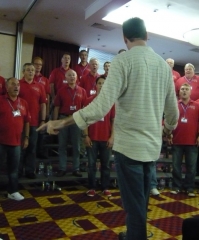
Royce Ferguson with the Cottontown ChorusRoyce Ferguson with the Cottontown ChorusAt the BABS convention last week I had the opportunity to observe Royce Ferguson coaching Bolton’s Cottontown Chorus. Royce is best known in the barbershop world as the director who took the Westminster Chorus to their first two international chorus medals in 2006 and 2007. It is not surprising therefore that he is in considerable demand as a coach and he is becoming a regular visitor to the UK in that capacity.

In his work with Cottontown he focused on the integrity of tone, on maintaining a sound that was neither breathy nor pushy. Indeed, he identified putting energy behind a breathy tone as the primary cause of vocal strain. He relentlessly insisted on a refinement of tone in which the voice is ‘always connected but never heavy-handed’. It is an active tone, not a passive one, which needs constant attention to keep it centred. He talked a lot about letting the natural beauty of the sound resonate without feeling the need to do things to it:

Start as you mean to go on

This post is a theme that emerged during my visit to Bristol Fashion last week, but which wanted enough thinking about to deserve a post of its own. It is, on the face of it, a rather obvious point: that if a chorus starts a phrase well, it continues well, whereas a hesitant or ragged or inattentive start leads to a lower level of performance throughout the phrase. This resonates with my observations of how one of the ways Peter Kennedy maintains performance standards at Green Street Blues is by not letting them continue after a substandard start. But it also brings out some extra dimensions that you can only spot when you can compare the continuations from both clean and rocky starts.

Successful Singing Secrets

successfulspeakingOn Tuesday I participated in a teleseminar on Chris Davidson’s book Successful Speaking Secrets Quick Reference, which was published at the end of last year. Chris became a full-time public speaker and speaking coach about 8 years ago, when he could no longer bear the dire quality of most of the presentations he had been witnessing in industry. He has made it his life’s mission to inveigle business leaders of the world into becoming interesting to listen to.

I had a direct interest in the subject as a presenter (and one with opinions, indeed). But I also found myself applying his ideas to the roles of the musical performer and the conductor as we went through. After all, being interesting to listen to is a useful quality for a musician to have, too. My impressions are a little miscellaneous as yet – this post is about rummaging through the plethora of things that caught my attention, but I think there are also a couple of Big Ideas that may emerge as posts in their own right when I’ve had time to live with them for a while.

Obsessiveness, Reluctance and Excellence

When I was organising the mutual mentoring scheme for arrangers, I had several conversations in which people said words to the effect of, ‘Oh, I must get round to doing some arranging’. I found this an interesting response because it is so different from my own relationship with arranging – which is probably best described as compulsive.

My first reaction was more judgemental than I like to admit: that the response was tantamount to an admission of mediocrity. If an activity is something you feel you should get round to, you’re just not doing it enough to be any good at it. You just wouldn’t say that if the activity was a regular part of your life’s activity.

Then I noticed I was being uncharitable, so tried to think a bit more openly about it.

Managing Stage Fright

At last week’s session of the Inspire Your Choir course I’m running for MusicLeader West Midlands, we had a really fruitful discussion about how to help our singers go into performances calmly and confidently and be happy that they can deliver their best to their audiences. It included lots of practical tips, and gradually three main themes emerged:

How Much Do Wrong Notes Matter?

There was an interesting discussion a while back among Barbershop Harmony Society Music judges about how much wrong notes should (a) affect our scores when judging and (b) be a focus for our evaluations. There was a general sense that the odd wrong note wasn’t too big a deal – especially with groups of middling attainment, where the occasional duff note rather goes with the territory. Gross or persistent errors, meanwhile, would have a greater impact on scores and would therefore become a higher priority issue to deal with in feedback afterwards.

So far, all fine and obvious. But it got me thinking about two things – the different dynamic in choral versus one-a-part ensembles, and what wrong notes tell us about musicianship.

...found this helpful?

I provide this content free of charge, because I like to be helpful. If you have found it useful, you may wish to make a donation to the causes I support to say thank you.


Archive by date

Syndicate content Syndicate content