
Music Theory

Musical Unity and Musical Vision

The Romantic idealThe Romantic idealOne of the aesthetic truisms that I absorbed during my undergraduate education, and have spent the subsequent years questioning,* is that great music has the quality of unity. This was purported to arrive in the music as the unconscious result of the composer’s genius, but could be uncovered via technical analysis. There were different dimensions in which you could identify this unity, Schenkerian tonal coherence and more or less hidden motivic connection in the manner of Réti being chief among them.

Even as a student, I was faintly perplexed by the equation of a spiritual attribute with concrete, technical details. I had a composer friend who was deeply taken by this aesthetic, and I used to ask him why, if the point about unity in great music was that it was created unconsciously, did he spend so much conscious effort constructing the motivic structure of his music? (He, on the other hand, felt I wasn’t taking our art sufficiently seriously when I upheld a valid role for whim in the compositional process.)

On Musical Comprehension

musicianship.JPGWhen I first started singing lessons at age 14, I was introduced to those standards of voice training, Vaccai’s exercises and Schirmer’s collection of 24 Italian songs and arias. At this stage, I was singing Italian phonetically – I knew the general gist of the words from the translations, but in expressive terms it was much like playing Mozart arias on the clarinet (which I also did around that age). Then at university I took Italian classes for 3 hours a week for a year, thinking it would be useful for someone taking voice lessons (and actually, interesting for someone who liked studying languages).

It was some years later again when I returned to the old Schirmer volume to revisit songs I had learned in my teens and had the bizarre experience of going through the motor actions I had learned to create the sounds, but now understanding the words I was singing. Bizarre and rather fun, I should add – I always enjoy the sensation when bits of my brain that hadn’t really connected before discover they have something in common.

On Range and Tessitura

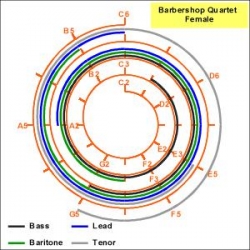
A rather nice way of showing vocal ranges visually, from PhonatureA rather nice way of showing vocal ranges visually, from PhonatureThis week saw the addition to my arrangements catalogue of information about the ranges for each part. It took quite a long time to work through all parts of every arrangement, but I’m hoping it will save you time in emailing me to ask, and me time in answering. And the process gave me lots of opportunity to reflect on the meaning and usefulness of this information.

At the most basic level, range is the primary criterion for deciding on an arrangement’s suitability for a particular ensemble. If the person singing that part doesn’t have notes used at either top or bottom, there’s no point attempting the song, as it will always over-stretch the group – and at key musical points, too. (Extremes of high and low notes never appear casually or en passant.)

But range doesn’t tell you everything you need to know about how a song lies on the voices.

Henry Coward and the ‘Line of Beauty’

Henry CowardHenry CowardI have been re-reading Henry Coward’s Choral Technique and Interpretation and it does not get less fascinating on re-acquaintance. Written in 1914, it is simultaneously a fascinating document of the musical practices and cultural values of his time, and a timeless statement of good practice for performing musicians. It is both intensely practical and deeply thought-through. Coward’s own character shines through as both strong-minded and idiosyncratic in all sorts of ways. He must have been wonderful to sing for.

The chapter on musical expression lays down a series of rules for beauty, at first in terms of painting (he credits Ruskin with putting him on this track), and then articulated as musical guidelines.

Managing Expectations in Vocal Arrangements

Regular readers will have noticed that I like to draw on the ideas of Leonard B. Meyer when I think about music. I was first introduced to his work in my first year at university, and it had quite a big impact on me, as it was my first real encounter with the act of theorising music. Hitherto most of the writing about music I had seen simply described what was going on, whereas this introduced me to the possibilities of explaining it.

(This early encounter also provided the occasion for possibly the most useful thing anyone ever said to me during my education. My tutor, Alan Rump, had sent me away to read some Meyer, and I came back saying tentatively that I found it very interesting but wasn’t sure that I agreed with it. ‘Good God, woman,’ he roared, ‘You’re not supposed to agree with books, you’re supposed to think about them.’)

Anyway, some recent listening experiences got me thinking about his implication-realisation model of musical meaning again.

A Cappella and the Creation of Rhythm 3: Melody & Accompaniment Textures

This is the third and final post in a series that looks at the consequences for the close-harmony arranger of Cooper & Meyer’s theory of rhythm. By looking at the way that musical structures create patterns of accent, we can draw a number of practical conclusions about how we control musical elements so as to make a coherent sense of rhythm without undue distractions.

In some ways, melody and accompaniment textures provide fewer challenges than homophonic textures, because they have more built-in contrast. The parts singing the accompaniment patterns can set up a regular metrical framework to drape the tune over, in much the way that a band’s rhythm section frees a soloist up to play with and pull against the basic rhythmic structure.

A Cappella and the Creation of Rhythm 2: Homophony

In my first post on this theme, I looked at Cooper & Meyer’s theory of rhythm, and in particular the way that it frames the idea of accent as any musical event that draws attention to itself. Of the types of accent discussed in that post, by far the most important for homophonic a cappella styles is the harmonic accent. Where all voices are singing the same words at the same time, and the number of notes sounding simultaneously is largely constant, the primary means to alert the ear to a song’s metrical shape is the changing of the harmony.

And indeed, both the arranging styles and performance styles of close-harmony traditions have particularly focused on relishing the harmonic content: it not only regulates the rhythmic flow of the music, but colours its entire emotional shape.

Crazy Copyright Case

soapboxOver on ChoralNet, they have a persistent running gripe about copyright legislation and the heavy-handedness with which big businesses in the music industry enforce it. I mostly try not to get too worked up about these things – it’s part of the landscape we work in and I have other more interesting uses for my emotional energy – though I do appreciate having voices of reason on the case lobbying for balance.

But there was a news story last week that has me mentally frothing at the mouth (if such a thing is possible). The music publisher Larrikin, who bought the copyright to ‘Kookaburra Sits in the Old Gum Tree’ in 1990, is apparently suing Men At Work for plagiarism, claiming that the flute riff in the 1981 song ‘Down Under’ is stolen from the girl guide tune.

...found this helpful?

I provide this content free of charge, because I like to be helpful. If you have found it useful, you may wish to make a donation to the causes I support to say thank you.


Archive by date

Syndicate content Syndicate content