
Back with the Barberettes
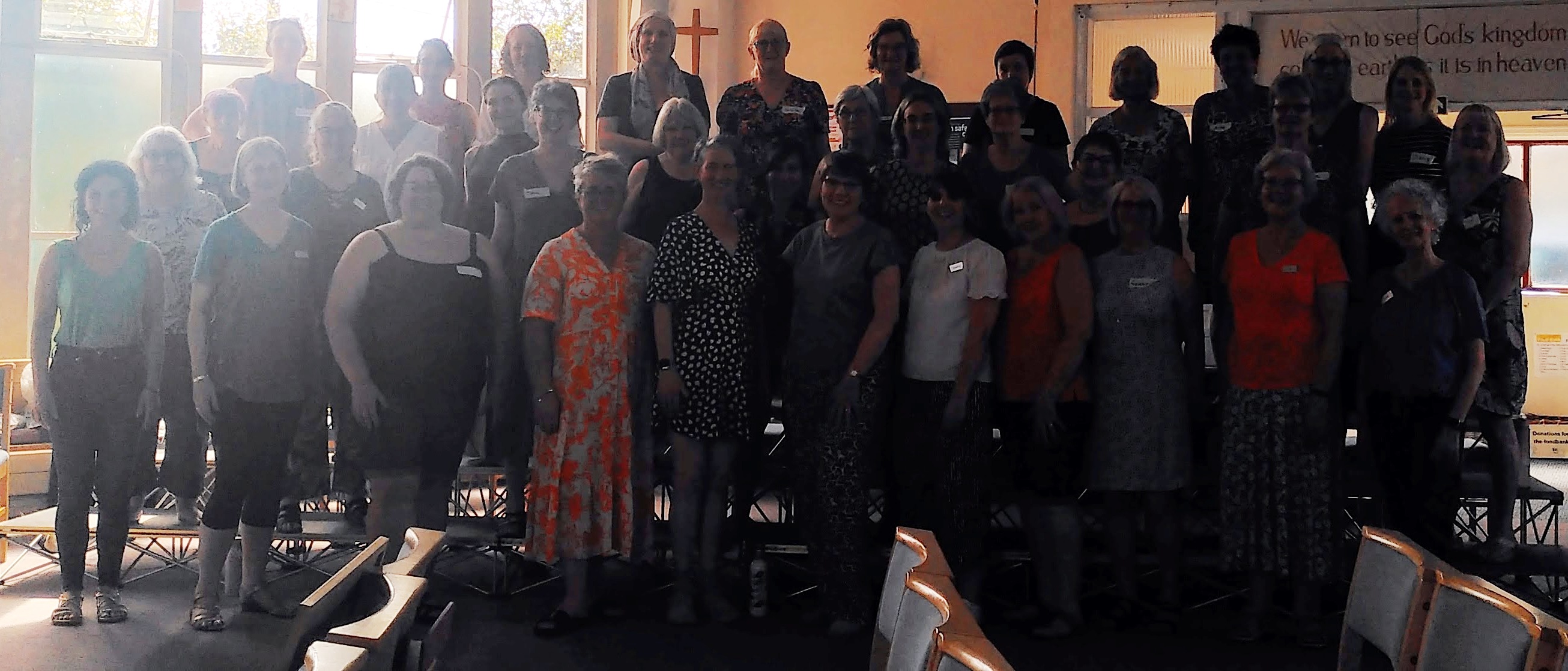 Here we all are in silhouette...
I last visited the Barberettes in Reading 26 years ago, and I think I may have been the only person there on Saturday who remembered the event. I had been sent there by LABBS to coach, shortly before I certified as a judge in the Music Category, and I recall I had recently decided it would be useful to be able to sing what we now call an Icicle 7thin a descending cascade, a skill I used for the first time on that visit and again on my return visit last weekend. I was right, it is a useful thing to be able to do.
The Barberettes are one of the longest-standing barbershop choruses in LABBS, although it is a decade or so since they have participated in the organisation’s national convention. As a result, their return to the contest stage in the association’s golden anniversary year sees them bringing a chorus that includes not only a member who has her 45-year pin, but also about 20 first-timers.
Accordingly, as well as our musical work for the day, we spent some time talking about preparing mentally for an unfamiliar performance experience with both stage and audience considerably larger than usual. Part of this is about framing the meanings of the experience: how the contest scenario gives a context and structure that brings everyone together into a shared experience, but it’s the sharing that is the ultimate point.
Of course the contest and its results are of interest (we wouldn’t have approached the coaching with anything like the focus we did were there not that major goal to aim for), but they don’t need to define how you fundamentally feel about yourselves. Participating is how you get to feel like you are at the heart of the event, with lots in common with all the people you’ll meet there.
We also talked about the experience of adrenaline, and how to accept and work with it rather than worrying about it. Unfamiliar events inevitably stir up more adrenaline than things you do all the time, but knowing to expect that and roll with it helps process that peak experience as a positively exciting ride. My comedy teacher used to say that if you feel adrenaline heading into a performance, the appropriate thought to have is, ‘Oh good, my body works,’ and that remains quotably useful advice years after I have stopped doing stand-up.
Our musical work focused on developing resonance and continuity of sound. We approached this via both how we use our voices and how we use our ears. Bubbling, virtual ear exercises, duetting, and calming down the jaw and tongue all had roles to play. One of the pleasing things to emerge from this process was demonstrating the mutually-supportive effect of these changes. Improving legato also cleaned up the sound, learning to listen in different ways helped glue the parts together more effectively, producing a clearer tone helped the breath last for longer.
Some of the singers commented on how quickly we managed to make significant changes to the chorus’s sound. This was in part, I am sure, due to the fact that I have considerable experience doing this stuff, and come in with a deep understanding of the world these singers inhabit, so I needed to spend less time on the trial-and-error process of working out what was needed here-and-now and could home straight in on exercises that were likely to work for them. Also, our shared LABBS heritage builds trust; although I hadn’t coached the chorus for years, I knew some of them from director coaching and quartet coaching, and they know my work as an arranger. It is much easier to get stuff done when people are pre-disposed to believe that we’re going to have a productive day.
But I can only take so much credit for the effectiveness of the learning. A lot of it also stems from the culture within the chorus itself. There was such a positive attitude to the learning process. This showed not just in the willingness to try things that felt challenging, but in the questions people asked. They were ready to articulate their needs, explaining what they found difficult or confusing, but in a way that sought solutions, and were willing to keep trying as we adjusted instructions until they found how to make things work for them.
There was also a strong sense of teamwork. This showed first of all in the kinds of comments people made during duetting: there was a genuine delight when people heard pairs of parts locking in to each other. And of course this celebration of others’ effective teamwork served to articulate and deepen the value placed upon it collectively. It was also evident later in the day when I invited the chorus to sing a passage without their director. This is always challenging, especially when you are not used to doing it, and even more so when you are singing a ballad in free tempo.
Even the first time through, the chorus did a much better job of this than they expected, with only one moment where they had to collectively correct for a hesitant entry. Once we’d identified the moment where two parts needed to be proactive to keep the momentum flowing, they took complete ownership of the delivery, with only the decision about exactly when to finish the final chord not entirely unanimous. The thing about the teamwork here was not just the ensemble skills involved, but the fact they took such pleasure in exercising them. It is always nice to succeed, but when you succeed in something you value, it is all the more special.


You may also like ...
|
Node 2,575
Weight = 5. Common link to https://www.labbs.org.uk/ (2), Three tags in common [32 posts have this] A Cappella, Coaching, Learning (3) 
|
Node 3,043
Weight = 4. Common link to https://www.labbs.org.uk/ (2), Two tags in common [256 posts have this] A Cappella, Coaching (2) 
|
Node 2,842
Weight = 4. Common link to https://www.labbs.org.uk/ (2), Two tags in common [256 posts have this] A Cappella, Learning (2) 
|
Node 2,981
Weight = 4. Links to Saturday Singing with Cantare Lunedì (2), Two tags in common [256 posts have this] A Cappella, Coaching (2) 
|
...found this helpful?
I provide this content free of charge, because I like to be helpful. If you have found it useful, you may wish to make a donation to the causes I support to say thank you.
Archive by date
- 2026 (27 posts)
- 2025 (24 posts)
- 2024 (46 posts)
- 2023 (51 posts)
- 2022 (51 posts)
- 2021 (58 posts)
- 2020 (80 posts)
- 2019 (63 posts)
- 2018 (76 posts)
- 2017 (84 posts)
- 2016 (85 posts)
- 2015 (88 posts)
- 2014 (92 posts)
- 2013 (97 posts)
- 2012 (127 posts)
- 2011 (120 posts)
- 2010 (117 posts)
- 2009 (154 posts)
- 2008 (10 posts)

It was a real pleasure having you come and coach us. Look forward to seeing more magic when the quartet come to you in January.