
Learning

Conversation Repair, Musicking Repair

You know when an acquaintance makes a comment that gets you thinking on and off for some months? I had one of those moments back in December and have been seeing new things in my music-making ever since. Her comment was about how she had always felt musical performance to be a high-pressure activity, as there was the imperative to keep going at all costs. She contrasted this with activities such as conversation in which people are constantly making mistakes and fixing them; conversation repair is part of the collaborative endeavour of interaction.

Now, I certainly recognised that sense of pressure she identified as something that probably also contribution to my own struggles with performance anxiety through youth and early adulthood. But I also recognised her description of conversation repair as something musicians do all the time in rehearsal (and, indeed, in performance).

Just Peachy Coaching

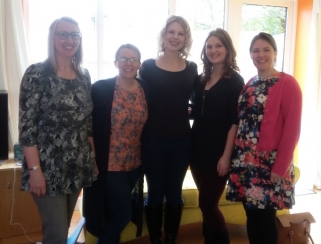
justpeachyContinuing the contest-preparation season, I had a visit on Monday from Just Peachy quartet, also gearing up to LABBS prelims in June. This is a new quartet in several senses - not only have they been singing together for only 6 months, but only one has previous quartet experience, and two of them are also very new to barbershop singing. It is most exciting to help people at these early stages of their journey!

(Oh, and for the numerate amongst you, the fifth person is an extra baritone, Helen, who will be kindly standing in so they can compete despite availability difficulties.)

Something I first noticed teaching piano 20 years ago is that when people come along having identified something they’d like help with, they’re often more than halfway there with that particular challenge. The fact they ask about it signals that they are aware of the need for attention and have already been working on it. There may be things that they’ve not yet put their minds to where I can actually make more of a difference.

ABCD Initial Course: Thoughts on Learning Structures

Justin Doyle's rather elegant illustrations of patternJustin Doyle's rather elegant illustrations of pattern

I spent Saturday up in Newcastle teaching conducting with Justin Doyle for the Association of British Choral Directors. This was the first of four full days, each a month apart, that makes up the abcd Initial Course. The course is very well established, though this is the first time it has run in this location and with this team. (The Newcastle course will also feature Martin Cook and Keith Orrell in future sessions.)

Regular readers will know that I like to think about the way the structure of events affects the learning experience, and there are several specific features of this course to reflect on in this context.

LABBS Harmony College 2016: Initial Reactions

Nickie James welcomes the assembled delegatesNickie James welcomes the assembled delegatesI am just home from a rather wonderful weekend with the Ladies Association of British Barbershop Singers, in which singers from all over the country gathered in Nottingham for a weekend of education and musical bonding. LABBS hasn’t used the Harmony College format for some years, having focused instead on themed and regional events on a rolling schedule. This has had the advantage of reaching more of the membership in total, as well as allowing those with multiple roles (quartet singer and chorus director, for instance) to access education for each. But there is a buzz about a big occasion like this that anyone who was there would not have wanted to miss.

I have, as you’d imagine, a pile of notes about things I learned and ideas I want to explore, both from the Directors Stream I was running and the plenary sessions. But in the first instance, as I’m writing this the morning after I got home, the impressions I’m processing are about this sense of occasion, and how it impacts on the learning process.

On the Locus of Control

I have been thinking again recently about the concept of the ‘locus of control’, something I have mentioned every so often in this blog, but not mused about at length for some time. This is the idea that how you experience and interpret events is strongly shaped by where you attribute causation. If you believe that you make things happen, you have an internal locus of control; if you believe that things happen to you, your locus of control is external.

So I guess the first thing to note is why it is desirable to have an internal rather than external locus of control. On one hand, it affects how you feel about things: the sense that what you do makes a difference makes you feel more purposeful, less passive. You feel more optimistic about the future if you don’t feel like the victim of circumstance. On the other, it affects what you can achieve. Not everything we attempt is destined to succeed, but if we go in with the mindset that we can shape our own destinies, we are more likely to attempt things more often and to persevere longer in the face of obstacles.

Two Penny-Drop Moments

Okay, so one person’s penny-drop is another person’s blindingly obvious, but I thought I’d share two ‘Aha’ moments I had this week so you can feel smug about how you’ve known about them for years. Both were about rehearsal planning, and both arose from specific circumstances that drew things I half knew but hadn’t thought about in detail into conscious awareness.

1. The Rehearsal Focal-Point

Attention span graphAttention span graph
So, we’ve known about the attention-span graph for yonks, and I am accustomed to following its implications in rehearsal planning by scheduling new stuff during the phase just after the warm-up where people’s cognitive capacities will be at their peak. ‘New stuff’ here mostly means new repertoire, though it may mean taking on a new challenge with established repertoire in the context of a particular performance goal. But you need something new to be working on most of the time to keep people feeling like this week’s rehearsal offers something different from last week’s or next week’s.

On Kahneman’s Two Systems and the Acquisition of Skill

kahneman

Last time I wrote about this, I gave an overview of the Daniel Kahneman’s model of two types of thinking we use, their functions, and their relationship. Today I want to mull over the implications of this for teaching and learning.

The ultimate goal of skill acquisition is to get System 1 doing all your routine operations. You want to be able to do your thing fluently, automatically, with ease and pleasure. It’s not just that it feels good to work in this mode, it’s that complex tasks need so many decisions to be coordinated that even if you had the cognitive resources to make them all in real time, it would be too slow to work properly. This is how it feels performing on a bad day when your inner voice is hectoring you: you react too late, and then you over-react.

Thinking Slowly About Daniel Kahneman

kahnemanYou know you really should read a book when you find several people you know from completely different contexts all independently saying you’d like it. And when the most recent recommendation comes just before a long journey, you’re primed to make an impulse purchase when you see that book in a shop at the airport. My friends know me well: Daniel Kahneman’s Thinking, Fast and Slow turned out to be exactly the kind of book I’d enjoy reading, and then mulling over repeatedly.

My purpose today is to organise my thoughts about his central model of two modes of thinking referenced in his title: the fast, intuitive, associative System 1 and the slow, effortful and painstaking System 2. There may be future posts where I work through the implications of this model in various contexts - principally the mechanisms of unconscious bias and the process of skill acquisition - but before I start to untangle those, I need to get my thoughts straight about the underlying concepts.

...found this helpful?

I provide this content free of charge, because I like to be helpful. If you have found it useful, you may wish to make a donation to the causes I support to say thank you.


Archive by date

Syndicate content Syndicate content