

Learning

Musicologie en Paris

Université Paris 8Université Paris 8

I’m going to interrupt my series on rehearsal techniques to stop and boggle for a bit about my trip last week to France for my first ever experience of a conference conducted mostly in my second language. I had been invited as one of two keynote speakers to a conference entitled Music and Gender: Current State of Research,* and although conference was genuinely international, with speakers from Brazil, Italy, Spain and Greece as well as France, England and Ireland, we were the only two to present in English.

Now, I have read a good deal of French over the years, including some reasonably dense music theory, so I wasn’t entirely unprepared for this. But most of my actual live interactions in the language have been of the ‘two beers and a cheese sandwich’ type, so in other ways this was something of a baptism of fire. I will have some thoughts to share on matters of music and gender arising from the papers and their discussion in due course, but my most immediate response is to want to reflect on what I learned about language, learning and communication from the adventure.

On the Fragmentation of Attention

I have often thought that when people complain of being short of time, it is more often that they are short of brain space. If you do an audit of every minute in your day, there are often plenty of minutes that are ‘unproductive’ if regarded from the outside. But, from the inside, you can’t make use of those minutes for anything very much because it just takes too much energy to upload something productive into your head for a brief time, and then - just when you’ve got going - dump it out again for something else.

This is of course that standard wisdom about why multitasking is inefficient - there are frictional costs of attention involved in every switch, so switch often enough and you get nothing done. Multitasking still has its place, I’d say, but only with routine tasks that you have at the tip of your brain anyway. I quite like the definition that multitasking is a technique for avoiding several dull tasks by doing them all at once.

Getting into the Detail with Cleeve Harmony

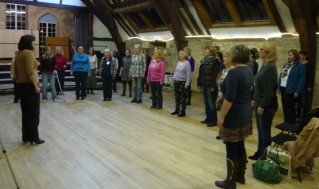
Cleeve Nov 2015As I was about to leave after my coaching session with Cleeve Harmony last Wednesday, their director, Donna, asked, ‘So what’s the blog going to be about?’ She thereby drew my attention to the process of reflection that goes into that decision. When we’ve only just stopped making music, all the multifarious things we have done together are all jumbled up in my head: vocal things, performance things, conducting things, musical things. It takes some time thinking back over it all to discover which bits are going to stand out as the bits I feel like writing about.

On this occasion, I awoke the next morning to the realisation that the part of the session that had stayed with me most vividly was an intensive 25 minutes or so focused on sorting out a sequence of just 7 chords that had never quite settled into place. You know the kind of passage - one you’ve got it near enough right that you get away with it in performance, but not right enough to feel happy with it.

Surrey Harmony and the Musical Music Team

Rubric for rehearsal pacing: using my special 'almost legible' writingRubric for rehearsal pacing: using my special 'almost legible' writingThursday night saw me doing another session for a chorus’s music team, this time with Surrey Harmony. It was a rather different dynamic from my last session - a similar number of people, but this time the entire team from a single chorus rather than a couple from each of several choruses. What we lost in the opportunity to compare experience between different ensembles we gained in the opportunity to develop mutual understanding and shared working methods within the group.

(As an aside: there is a truism lurking in there about the learning process. What you can learn in any given scenario is to some extent a function of your own needs, beliefs and habits, but it is also a function of who you are learning with.)

BinG! Harmony College: Further Thoughts

The women's chorus in the final concertThe women's chorus in the final concert

I mentioned in my last post about the BinG!* Harmony College that they held a contest on the first evening to select the quartets to compete in their Convention next March. This was useful not just for the coaches to starting diagnosing learning needs, but it was a valuable part of the overall learning experience. And over the four days of the college, there were three general sessions structured around performances, and I have been reflecting on what they contributed to the overall effectiveness of the event.

Developing Section Leaders

Since I had to travel down to Plymouth the day before my coaching day with Brunel Harmony, their director Delyth Knight had a brainwave about how to use the evening before. Her family are involved in the musical leadership of several choruses in the area, so she felt it would be a good opportunity to offer a training session to section leaders/music team members from several of them together.

Interestingly, I have been toying with offering training for music teams as a specific service for a while, as it strikes me as a way to support the ensemble’s development in a way that could add significant value relative to the time spent. And, whilst there are plenty of training opportunities to develop the musical and vocal skills these roles need, there is relatively little support for how to develop the coaching and mentoring skills they often entail.

Then, while I was toying with these ideas, two directors got in touch independently to ask about them. It is starting to look like an idea whose time has come.

Learning with Lemov: Without Apology

In my early years as a lecturer, I was teaching a class on music analysis one day, when a student asked, ‘And why are we learning this?’ It’s the kind of question that can come over as quite confrontational, especially when you are feeling new to the game. But it’s also a good question to ask every so often. So I talked for a short while about why I thought the method we were looking at was useful to musicians (I suspect it was Schenker, but can’t actually remember for sure). The student accepted my answer, and we went on with the class, all of us feeling some relief that we weren’t wasting our time together.

This incident came back to me as I read Doug Lemov’s principle of teaching Without Apology. If we implicitly (or indeed explicitly) apologise for the content we deliver or the people we deliver to it, we lower expectations about both the achievements that are possible or the rewards that come from achieving it. If we don’t believe in what and who we teach/conduct, who will?

So that’s a principle that’s easy to agree with in the abstract, but let’s look at some of the ways it can play out in a choral context.

Confidence, Competence and the Dunning-Kruger Effect

If you've not seen this movie, I'd recommend it for all kinds of reasons, including its illustration of the Dunning-Kruger EffectIf you've not seen this movie, I'd recommend it for all kinds of reasons, including its illustration of the Dunning-Kruger EffectI wrote some time ago about the relationship between confidence and competence, and how when prioritising learning needs the former can often act as a reasonable proxy for the latter. There was, however, some interesting psychological research towards the back end of the last century that identified circumstances in which this correlation not only breaks down but becomes positively misleading.

The Dunning-Kruger Effect refers to the way that people who are grossly incompetent at a skill will cheerfully think they are quite good at it, as below a certain skill threshold you lack the knowledge and awareness to recognise how truly bad at something you are. Conversely, experts routinely underestimate how much better they are then the merely competent because one of the hallmarks of expertise is being able to do something fluently and without struggle.

This means that if you meet someone who describes an activity as ‘ not that hard’, they are likely to be either very very good at it or very very bad.

...found this helpful?

I provide this content free of charge, because I like to be helpful. If you have found it useful, you may wish to make a donation to the causes I support to say thank you.


Archive by date

Syndicate content Syndicate content