
Learning

Learning with Lemov: What To Do

This is another technique presented by Doug Lemov in his collection of methods for classroom discipline that, to my mind, resonates strongly with his techniques for actual teaching. It’s quite simple, but very powerful: if you want someone to do something, tell them exactly what actions they need to take.

To elaborate: quite often if children (well, people) fail to follow an instruction, it’s not that they’re being deliberately obstructive, merely incompetent. An instruction such as ‘Behave yourself!’ is ambiguous; it tells the child they’re doing something wrong, but doesn’t state what’s actually required. Even the more specific, ‘Stop fidgeting!’ only makes it clear what’s wrong, not how to fix it.

‘Please sit down and face this way,’ gives a nice clear to-do list, and even a child who is in something of a bolshy mood might find it easier to just to get on with it than continue to resist in the face of such calm clarity.

A Fascinating Rhythmic Widget

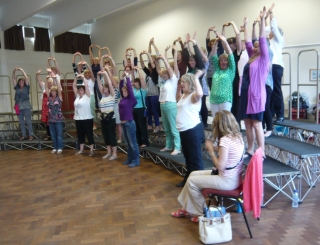
If you wonder why all my chorus pics are of warm-ups, that's the only time I have a moment to use the camera!If you wonder why all my chorus pics are of warm-ups, that's the only time I have a moment to use the camera!On Thursday I went down to Bristol for the first of two visits working with Fascinating Rhythm on music they are preparing for the Ladies Association of British Barbershop Singers Convention in the autumn. The main challenge for the song we were working on in this first visit was getting a handle on Latin rhythms. They were at that point where they felt they were finding their way into the musical world, but not with absolute confidence.

So, what they really needed was a sense of method. It was one thing to work on the rhythms there and then with them, but I wanted to leave them with a set of steps they could go through, both in individual practice, and at subsequent rehearsals, to reconstruct the process we had gone through and so be sure in their own minds that they were getting it right. For a convincing performance, everyone involved needs to know they can make the effect happen at will.

Learning with Lemov: Achieving 100%

As an addendum to my post from last week on Lemov’s principle that 100% compliance with instruction is fundamental to the achievements of a class (and by extension, in our context, a choir), I thought it worth going into a little more detail about some of the guidance he gives for how to achieve this. It does sound scarily draconian on first acquaintance, but the point of it is to make the culture of compliance invisible so that everyone just gets on with things without having to stop and belly-ache about it.

His first point is that we should always use the least invasive form of intervention. If you can get someone back on task using just eye contact, that’s all you should use. A reminder to the group as a whole can be a way to reinforce the universality of expectations while bringing attention to the fact they still need to be met. If it needs individualising, you can start this off anonymously - I particularly liked the formulation, ‘Still waiting for 3 people...1 person...and we’re ready to go’ as a way to make individuals accountable without drawing negative attention to them.

How Do I Get to Be an Arranger?

I had an email recently introducing me to a 12-year-old who was expressing an ambition to study music in college and become a barbershop arranger. Some of her questions were unique to her circumstances, but the general issue of what kind of things should she be doing to position herself to be ready at age 18 to fulfil these ambitions are things I thought worth discussing here. After all, though I am mildly boggled at someone having such clearly formed ambitions at that age (I am sure I didn’t!), she is probably not the only person wanting to tread such a path.

So the first thing to point out is that studying music in higher education is moderately unlikely to include studying barbershop arranging per se; it is a genre that may occasionally appear briefly in college curricula, but you can generally expect your education as a barbershopper to be largely self-directed. Don’t let that stop you studying music; I’m just clarifying so as to set your expectations. Studying music will make you a much better barbershopper, and doing barbershop will be great for your musicianship. Just be aware that it is a niche specialism within a wider discipline.

Learning with Lemov: Right is Right, 100%

As I read through my last post on Lemov’s classroom techniques in preparation for starting this one, I noticed how certain central themes are already emerging. In particular, the principle that giving people the discretion to decide whether they commit their efforts and attention to the job in hand makes it harder for everyone to get on with it also lies at the heart of the two elements I’m going to look at today.

Lemov places ‘Right is Right’ and ‘100%’ in different sections of the book, the first in the section on setting high academic expectations, the second in the section about setting and maintaining high expectations for behaviour. Of course, both sections are about expectation-setting, so it is perhaps not surprising that their content resonates together. But it seemed to me that the two principles are much closer in the choral rehearsal than they are in the classroom, and it will be interesting to explore why.

Time Management, Brain Management

I was having an online conversation with some choral directors recently in which we were grappling with the perennial issue of how to fit in preparation of music. In particular, the issue was the prep needed for special events above and beyond your regular musical activities. The person who started the conversation is going to two training events over the summer that each require prior learning of music and was finding herself in a state of some overwhelm trying to fit this in around an already busy schedule.

This is in a music-specific version of the classic workflow issue of how you accommodate projects within a role that is already full-time. By their nature, projects are relatively short-term commitments that start, go through a period of focused activity, and then finish. So they demand considerable inputs of time and attention, but since they are inherently temporary, you rarely have that kind of time and attention going spare in your capacity. Take on two at once and you get a real bottle-neck.

Learning with Lemov: No Opt Out

One of the first techniques Doug Lemov introduces in his collection of classroom methods is the principle of No Opt Out - the notion that students don’t get to choose whether or not to participate, or indeed whether or not to succeed. It is interesting to consider, both because of the way it typifies his approach of finding practical ways to structure classroom interactions so as to embody a fundamental set of values, and therefore also as a case study for adaptation to the choral rehearsal. The specific form(s) of the interaction will change, but we can still find concrete, actionable steps to embody the principle.

So, the way this plays out in the classroom is as follows. The teacher asks a student a question. If they answer correctly, fine, carry on. If they struggle to answer, or try to slide out of trying to answer by saying ‘I don’t know’, the teacher finds a way to help them out of the impasse, but makes sure the interaction ends up with the student stating the right answer.

Values and Skills Audits with Bristol Fashion

BFjun15Over the last couple of weeks I have been helping Bristol Fashion with a similar kind of review/audit process that I undertook with Hallmark of Harmony back in March. As with that exercise, I am not going to share the detail of what the review produced here - as that is for the chorus use - but I would like to reflect somewhat on the process.

The review with Bristol Fashion worked as a two-stage process. It started off with a visit to observe their Music Team in action on a regular rehearsal night, which produced a report that identified things that are working well (i.e. to make sure they keep doing them!) and areas that can be developed as individuals and as a team.

This was followed, two weeks later, by a second visit in which I facilitated a values- and goal-setting exercise with the whole chorus. The aim of this was for the singers to articulate to each other the things that matter the most to them about their musical life together, and to generate concrete actions that each individual could undertake to enhance their shared experience.

...found this helpful?

I provide this content free of charge, because I like to be helpful. If you have found it useful, you may wish to make a donation to the causes I support to say thank you.


Archive by date

Syndicate content Syndicate content