
Rehearsing

The Intervention and Enforcement Cycles, Part 1

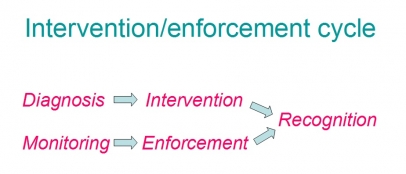
Following on from my post on rehearsal pacing, here at last is the first post about the Intervention and Enforcement Cycles. These describe the two fundamental processes that underlie the process of rehearsing an ensemble, and which can thus be used to analyse the detail of what we do with our choirs and maximise both the efficiency and effectiveness of our work with them.

Today I will outline how they work, and what the main differences are between them. In my next post I will discuss some common inefficiencies whereby directors let effectiveness leak out of their rehearsals. And the third post will give some extra hints and tips for good practice.

So, the two cycles look like this:
intervention

On Rehearsal Pacing

Rubric for rehearsal pacing: using my special 'almost legible' writingRubric for rehearsal pacing: using my special 'almost legible' writing
This is the first of a series of posts about efficient rehearsal techniques, about ways to get maximum bang for your rehearsal buck. The ones that follow are about the Intervention and Enforcement Cycles, which I keep mentioning with a promise to get around to blogging about them one of these days. That day is nearly here, but talking about rehearsal pacing is a useful set-up, so I’m doing this one first.

This diagram gives a usefully quick and dirty way of assessing the pace of a rehearsal by mapping patterns of activity on the choir’s experience:

So, long periods of talking will slow down the pace of rehearsal, and if combined with short bursts of singing, will send your singers home bored. Short periods of talking, conversely, give less opportunity for the singers to disengage. Combined with short bursts of singing, you get a fast-paced rehearsal, or with longer spans of musical time it becomes more relaxing.

Choir Discipline, Conductor Discipline

I was working with a relatively novice conductor recently who was grappling with the challenge of how to command the attention of the choir. Anyone who has spent time either teaching or running rehearsals will sympathise, indeed will probably have had recurring anxiety dreams about failing to do so. (Please tell me I’m not the only one who has these!)

So we started out looking at various specific techniques you can use to command a room (more of which below), but very soon stumbled over a fundamental point that underpins their success or failure. It relates to the truism that you can’t control anyone else’s behaviour; all you can do is create an environment in which they will choose to control their own in the ways you desire.

How to build a warm-up

I wrote these notes for a session at Magenta’s retreat back in September in which a team of seven choir members prepared and led one element each of the warm-up. This was part of our general principle of handing round leadership in various activities as a way to develop the choir as a whole through experiencing different people’s perspectives, and the individuals within it through the act of leading. It was also intended as a way to raise everyone’s awareness of the elements of warming up and thus increase our sense of purpose as we engage with it each week.

As so often happens when I’ve written some notes for Magenta, I thought: you know, other people might find these useful too. Let’s publish this as a blog post. So here you go.

Adrenaline and Tempo: Taking Control

I recently had a question from a director that struck me as one of those that I’m sure a lot of us grapple with on occasion. So I gave her some specific advice for the performance she was preparing for in the immediate future, but said I’d give it a think and blog in more detail about other things to consider after the big gig.

This was her question:

When I'm directing, even if in my head it's painfully slow.... It's much faster! I know it's linked to my nerves/adrenaline of competition but recently realised it happens a lot

My immediate advice was twofold:

On the Usefulness of Humming

After one of my ‘Make Your Nerves Work For You’ classes at BinG! Harmony College, one of the participants came up and remarked that I had mentioned humming in several different contexts, and could I give her a list of the different uses it has. My reply was: that sounds like a follow-up blog post. So here it is. A little way after the event, but there’s been quite a lot of stuff going on just lately that I wanted to blog about as it happened.

I suppose I should start with humming as a form of singing. As an activity to use in the warm-up, it is a nice gentle (and safe) way to start phonation and get the voice moving - I guess it would be possible to hum with voice-damaging tension if you deliberately tried to, but it’s pretty unlikely to happen by default. And while you’re at it, you can focus on activating the resonant cavities in your head to enhance both the richness and brightness of your sound.

Dr Jim’s Lemov Moments

At the moment when Jim Henry served as guest educator at the Directors Weekend I ran for the Ladies Association of British Barbershop Singers back in July, I had just spent two months dipping into Doug Lemov’s intensely useful book Teach Like a Champion. Having by then written a good handful of blog posts about how Lemov’s classroom techniques can play out in the choral rehearsal (and having made notes for more posts, which came along later), my brain was primed to spot them in action. And Dr Jim - seamlessly and without fanfare - provided a walking compendium of their application throughout the weekend.

Here are some of Dr Jim’s Lemov’s moments. You can see him in action in the clip above, but these comments come from notes made over the entire three days

Developing Section Leaders

Since I had to travel down to Plymouth the day before my coaching day with Brunel Harmony, their director Delyth Knight had a brainwave about how to use the evening before. Her family are involved in the musical leadership of several choruses in the area, so she felt it would be a good opportunity to offer a training session to section leaders/music team members from several of them together.

Interestingly, I have been toying with offering training for music teams as a specific service for a while, as it strikes me as a way to support the ensemble’s development in a way that could add significant value relative to the time spent. And, whilst there are plenty of training opportunities to develop the musical and vocal skills these roles need, there is relatively little support for how to develop the coaching and mentoring skills they often entail.

Then, while I was toying with these ideas, two directors got in touch independently to ask about them. It is starting to look like an idea whose time has come.

...found this helpful?

I provide this content free of charge, because I like to be helpful. If you have found it useful, you may wish to make a donation to the causes I support to say thank you.


Archive by date

Syndicate content Syndicate content