
Rehearsing

Learning with Lemov: Achieving 100%

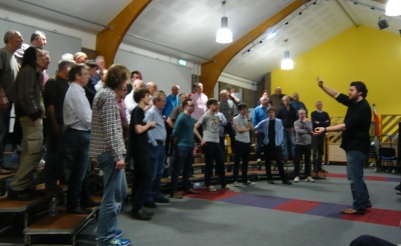
As an addendum to my post from last week on Lemov’s principle that 100% compliance with instruction is fundamental to the achievements of a class (and by extension, in our context, a choir), I thought it worth going into a little more detail about some of the guidance he gives for how to achieve this. It does sound scarily draconian on first acquaintance, but the point of it is to make the culture of compliance invisible so that everyone just gets on with things without having to stop and belly-ache about it.

His first point is that we should always use the least invasive form of intervention. If you can get someone back on task using just eye contact, that’s all you should use. A reminder to the group as a whole can be a way to reinforce the universality of expectations while bringing attention to the fact they still need to be met. If it needs individualising, you can start this off anonymously - I particularly liked the formulation, ‘Still waiting for 3 people...1 person...and we’re ready to go’ as a way to make individuals accountable without drawing negative attention to them.

Learning with Lemov: Right is Right, 100%

As I read through my last post on Lemov’s classroom techniques in preparation for starting this one, I noticed how certain central themes are already emerging. In particular, the principle that giving people the discretion to decide whether they commit their efforts and attention to the job in hand makes it harder for everyone to get on with it also lies at the heart of the two elements I’m going to look at today.

Lemov places ‘Right is Right’ and ‘100%’ in different sections of the book, the first in the section on setting high academic expectations, the second in the section about setting and maintaining high expectations for behaviour. Of course, both sections are about expectation-setting, so it is perhaps not surprising that their content resonates together. But it seemed to me that the two principles are much closer in the choral rehearsal than they are in the classroom, and it will be interesting to explore why.

Learning with Lemov: No Opt Out

One of the first techniques Doug Lemov introduces in his collection of classroom methods is the principle of No Opt Out - the notion that students don’t get to choose whether or not to participate, or indeed whether or not to succeed. It is interesting to consider, both because of the way it typifies his approach of finding practical ways to structure classroom interactions so as to embody a fundamental set of values, and therefore also as a case study for adaptation to the choral rehearsal. The specific form(s) of the interaction will change, but we can still find concrete, actionable steps to embody the principle.

So, the way this plays out in the classroom is as follows. The teacher asks a student a question. If they answer correctly, fine, carry on. If they struggle to answer, or try to slide out of trying to answer by saying ‘I don’t know’, the teacher finds a way to help them out of the impasse, but makes sure the interaction ends up with the student stating the right answer.

Soapbox: On ‘Leaners’

soapboxThis is a spin-off from my current project of adapting ideas from Doug Lemov’s taxonomy of effective classroom methods to the rehearsal room. As I wrote my introductory post on the project, I had the following tangential thoughts on a subject that is a mainstay of choral discourse.

It is a widely-held truism that ‘leaners’ are a Bad Thing for a choir. Their failings may be treated as moral deficits: that they are lazy in letting other people do their learning for them. Or they may be seen as lacking in ‘talent’, and thus a drag on the choir’s progress. The literature tends to treat them quite impatiently, with the basic imperative that they just need to get a grip and learn to think for themselves. The very label ‘leaner’ places the blame for their condition squarely on their own shoulders.

But it occurred to me when writing about Lemov’s techniques that there are two kinds of leaning going on in choir, and they need quite different solutions.

Converting Drains into Radiators

My friend Monica Funnell introduced me to the classification of people into radiators and drains in a recent conversation about how directors can build effective teams. It is one of those wonderfully self-explanatory concepts that sheds immediate light onto aspects of interpersonal relationships in real life. And, as these things are apt to do, it helped me identify what’s been going on in situation that has been a source of low-grade anxiety in my own life.

But the thing about these personality labels is that they’re more useful in some situations than others. If you are putting together a group of people to work together, yes it’s very useful. If you are going in for a spot of introspection, it could potentially be useful, depending on how self-aware you are. (One of my niggling questions is whether drains know they are draining; I’m reasonably sure the person I’ve been worried about thinks they are a radiator. This in turn fills me with self-doubt: does everybody else see me as needy and whining without my realising it?)

Why You Need to be Able to Demonstrate All the Parts

This is an addendum to my post on preparing music to direct. I had a response from a director saying that his section leaders are charged with demonstrating their parts in rehearsal, and that he thought his time would be better spent doing various analytical tasks such as harmonic or voicing analysis. Now, I’m not one to discourage harmonic or any other kind of analysis, so please do continue doing this. But his comment made me articulate to myself why you still need to be familiar enough with all the parts to be able to demonstrate them in rehearsal.

When I’ve asserted this before, it has been in the context of why you need to know all the parts, and the ability to demonstrate them has been the measure of when you know them well enough. But this comment focuses the attention on why you also need to be able to demonstrate anything your singers might have to sing as a distinct desideratum in its own right.

Hallmark Healthcheck

Hallmark

Nearly three years ago I visited Hallmark of Harmony in Sheffield to spend an evening observing their rehearsal prior to producing a report to feed into their five-year plan for the chorus’s development. In the intervening time they have gone from success to success, having won a succession of contest medals, the most recent one of which has qualified them to go and compete at the Barbershop Harmony Society’s International Convention this summer.

This week I went back for a return visit, which they framed this time as giving them a healthcheck. This seems a most apt metaphor - they have clearly found their mojo as a chorus and didn’t need help fixing problems that were conspicuously holding them back. But just as if you wait until you are suffering to seek medical advice, you miss the opportunity to nip ailments in the bud, reviewing how you are getting on as a chorus while things are going well can help you head off issues that could become problems in the future. You can also identify ways to turn good health into even better health - indeed a chorus has rather more scope to do this than the medical profession!

The Quandary of the Abandoned Assistant: Part 2

In my previous post on this subject, I was mulling over the phenomenon of reduced attendance at rehearsals taken by an assistant rather than front-line director. I had got as far as analysing it as a side-effect of the director’s function in creating charismatic encounters. It’s not that the assistants are not inspiring and compelling as people, it’s that it is the role itself of director that confers the power to galvanise.

We had got as far as starting to think about the routinization of charisma when the post got too long, so that’s where we’re starting today.

To recap the theory: Weber’s classic formulation of charismatic authority, upon which pretty much all sociological studies in this area build, saw it as an essentially volatile social relationship, born in situations of crisis, outside and indeed often in opposition to, more stable forms of authority (such as the traditional or bureaucratic). Later studies have observed that, whilst this inherent instability is often apparent in charismatic groups, some organisations manage to sustain themselves for considerable lengths of time.

...found this helpful?

I provide this content free of charge, because I like to be helpful. If you have found it useful, you may wish to make a donation to the causes I support to say thank you.


Archive by date

Syndicate content Syndicate content