
Coaching Micro and Macro with Capital Connection

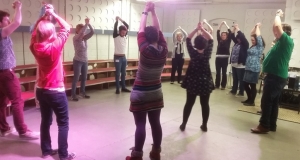
CapCon17The weekend after my visit to Bristol A Cappella took me, first, down to London to work with my friends at Capital Connection. (The second part of my tour, to Norwich, follows in a subsequent post.) We were working on a contest package that they had originally planned for LABBS Convention 2016, but which they had subsequently decided needed a longer development phase, so they will be taking it to this year’s European Convention instead.

One of my hopes for this convention is that all our international visitors will think, ‘Gosh, they’re doing interesting music in LABBS,’ and Capital are contributing to this ambition with the contest premiere of an arrangement by their director Debi Cox. Coaching an arrangement directed by its arranger is strangely very like coaching any other arrangement – the same process of music analysis and performance diagnosis – except that when you point out to the singers, ‘That’s a nice bit of arranging there,’ the person you are praising actually gets to hear and appreciate the compliment.

Blonde Ambition

Thanks to the quartet for sending a pic since I forgot to take one!Thanks to the quartet for sending a pic since I forgot to take one!I spent a chunk of the May Day bank holiday with Blonde Ambition quartet. When they first booked the coaching session, it was with the intention of preparing for LABBS prelims in June, but due to an administrative mishap, they will not now be competing this year. The bright side of this is that we could do all kinds of deep work on building technique and working methods that you would never undertake a few weeks ahead of a big performance.

There were two main areas we addressed. First, the intake of breath. Their general approach to breath management was pretty good – they were engaging their support well to produce a nicely resonant and focused sound – but the moment of inhalation was inserting a couple of obstacles into the process. One was a tendency to lift the top of the chest, which introduced some tension and stopped the breath sitting as deeply as it could. The other was a tendency to lift the chin slightly as a result of a slight contraction of the muscles in the back of the neck, which prevented a truly silent breath. (Alexander Technique practitioners would know this as ‘pulling down’.)

The Paradox of Conductors’ Leadership Styles

ICA course materialsICA course materialsThere is a fair amount written in the literature, both of conducting studies and leadership/management studies, about the leadership styles of conductors. People in business are a bit envious of the audible unanimity conductors elicit, and rather more envious of the glamour in the cultural images that surround them.

Musical studies tend instead to use concepts of leadership style taken from business to analyse conductor behaviour. The generalisation here is that once upon a time autocracy was the accepted norm, but that you are expected to be rather more polite these days. Phrases like ‘servant-leadership’ get bandied about.

Exploring Resonance and Emotion with Bristol A Cappella

Another warm-up shot: "Bananas of the world unite!"Another warm-up shot: "Bananas of the world unite!"I spent the first two days of the bank-holiday weekend with my friends at Bristol A Cappella. We had two full days for coaching the chorus, plus a two-hour session on the Saturday night for music-team training. One of the (many) triumphs of the weekend was pacing it so that we were still capable or productive work during the final hour of Sunday!

Another challenge is working out exactly what to blog about, since by definition when you have considerably more time together than usual, you have considerably more eventful and interesting things to think about on the way home. And considerably less brain with which to do the thinking, come to that.

Left-brain, Right-brain, and Other Pseudo-scientific Clichés

This is one of those posts that emerges from the confluence in my head of conversations with several different people over the course of a few months. What I really want is to get the various people involved into the same room together and say ‘You know what you were talking about with me in January? Say it them to see what they come back with.’ But in the absence of that opportunity (and in the recognition that even if I did they’d all probably have moved on and would want to talk about something else) I’m going to have to use my own imagination instead to work out the connections and contradictions.

There were at least two conversations about left-brain versus right-brain thinking, one in the context of teaching and learning, the other a report of a speaker who had reinterpreted the dichotomy as one of focused attention versus peripheral awareness. There were also discussions of a study that contends that the concept of ‘learning styles’ has no evidential validity, and just functions as a self-fulfilling educational ideology. All these landed into a brain that was already brewing thoughts about how much of the claims made for the health benefits of singing are presented in ways that claim a scientific basis with very little reliable underpinning.

More Musings on Mindsets

After my introductory post on Carol Dweck’s work on mindsets, I promised to come back and tease out the connections with themes previously explored in this blog. For there are many. You will have noticed that I am quite rabidly growth-oriented in my stance as an educator, so there are lots connections to be made. The challenge is going to be organising them…

At the big-picture level, there are a cluster of themes I have explored over the years. Long-term readers will have seen my critique of the discourse of talent become increasingly hard-line each time I come back to it, and Dweck’s analysis will only encourage me in this dimension. Indeed, now I go back and look at my thoughts on the dangers of being young and talented, it looks awfully like her accounts of fixed-mindset difficulties.

The growth mindset, by contrast resonates strongly with my past musings on expanding your boundaries and our relationship with challenge. And one of Dweck’s key findings, for me, is the insight that your beliefs about capacity and skill determine whether you experience challenge as an adventure or a threat.

Musings on Mindsets

mindsetCarol Dweck’s research on the nature and ramifications of different mindsets is one of those ideas that has percolated through our culture quite thoroughly over the last few years. I have found myself in conversations about it with friends in teaching, and friends with small children, as well as coming across it in miscellaneous ephemeral self-help type articles online.

The general outline is probably as familiar to you as it is to me: there are two broad mindsets or belief-systems about human capability, the fixed mindset (belief that capacities are essentially innate) and the growth mindset (belief that capacities are largely learned). These shape how you go about what you do, and how you respond to others.

But eventually there comes a time when you realise you’d better actually read the book itself, not just rely on second-hand knowledge.

Playlist 2017: 3rd commentary

Time for a few words on my growing playlist of music by women. The overall sentiment I am feeling regularly as I add to it is, ‘Why did I not know this before?’

  • Alice Mary Smith, Symphony in C Minor (1863). This was a composer of whom I had no previous knowledge. That stereotype that women in the 19th century wrote in smaller forms (whether because of their inherently domestic nature, or their lack of opportunities to work with larger ensembles) turns out not to be a very safe generalisation.
  • Undine Smith Moore, Afro-American Suite (1969) - I. Andante, II. Allegro molto e marcato, III. Adagio ma appassionato, IV Allegro molto e marcato. I have been thinking quite a lot recently about the way classical music appropriated and commented upon African-American musics in the early years of the C20th (Debussy: I’m looking at you). It is fascinating to hear this cultural dialogue presented from a different point of view, with a much more complex and nuance sense of interchange.

...found this helpful?

I provide this content free of charge, because I like to be helpful. If you have found it useful, you may wish to make a donation to the causes I support to say thank you.


Archive by date

Syndicate content