
Playlist 2017: First Commentary

My musical adventure for 2017 is coming along nicely. I’ve been adding a new item to the playlist of women’s music every few days, and it turns out the goal of making it up to 100 items during the year means that it is never very far from my mind. I’m still thinking about the last one when it’s time to look for another.

So far, my search process is very informal. I think: which female composers do I know about, but not know very much of their music very well? I pick an example that seems rather different from the last one, and then have a furtle about in youtube. I can imagine I’ll have to get a bit more organised as I go on, but there is time for that later.

One thing that is abundantly clear already is what a wealth of music is readily available. The limitations on programming and curriculum decisions are really about the internal knowledge-scapes of the programmers and curriculum designers, not the lack of possible material. Looking at exam syllabuses and concerts and radio listings, you’d think things haven’t really progressed that much in 25 years, but we are so much better resourced for listening opportunities than a quarter of a century ago, it is really very cheering.

More Artistry in Amersham

AmershamJan17Tuesday last week took me down to Amersham to work with current LABBS chorus champions, Amersham A Cappella on the wonderful ballad that helped secure their gold medal back in October. For, they may already triumphed with it, but there was still more music to hidden within in, and my task was to help them bring it out.

The song is a 1950s adaptation of Chopin’s Etude in E major, which added words to the outer, melodic sections to turn it into a love song. The challenge for a pianist is how to string these relatively slow-moving notes together into a continuous line, given that every note on a piano dies as soon as it is struck.

Singers obviously have the advantage of being able to produce a genuine continuity of sound, but they still need to generate flow and flexibility out a line of even crotchets, and there is a lot to be learned from listening to how pianists handle this. So, I had sent some listening homework to the chorus in advance – three pianists’ performances, Jo Stafford’s classic recording of the ballad, and the Ambassadors of Harmony’s performance from the 2012 BHS International Convention – along with some commentary of what to listen out for.

Right Sex, Right Instrument

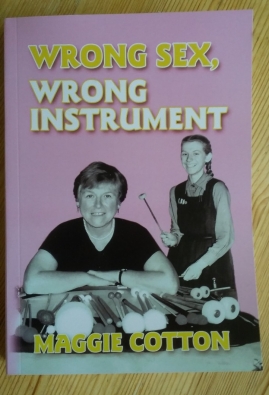
cottonbookLast week I attended a talk, hosted by the Balsall Heath Local History Society, by Maggie Cotton about her career as the UK’s first female percussionist in a professional orchestra. It bore the same title as her autobiography, ‘Wrong Sex, Wrong Instrument,’ which was the reason she was given, age 19, for being refused a grant to study at the Royal Academy of Music.

The talk was, as you can imagine, fascinating in many dimensions. My main focus in blogging about it is going to be the dimension of music and gender – unsurprisingly, given my interests as a musicologist all these years. But one of the striking things about the talk, notwithstanding its title, was how little gender obtruded into the stories. Most of the time it was a collection of tales from a percussionist, about her travels, about the instruments, about the conductors, composers and fellow players she had worked with.

Magenta News

Magenta2017In my New Year post I mentioned that I would be seeing a significant change in 2017, though was not at that point quite ready to talk about it. And whilst it’s still too soon to reflect in any depth, now is the moment to tell you that yesterday Magenta, the choir I founded 10 years ago, gave its last concert in its current incarnation.

The reason we are stopping is a concatenation of circumstances happening in Real Life (work, family, health, relationships – the usual) that led to a significant number of established members needing to leave in a short space of time. Our plan as of the middle of the autumn had been to recruit in the New Year – a good time of year to find people on the lookout for new adventures – and start a new cohort after our concert at the end of January.

New Feature: Availability Calendar

availabilityJanuary is one of the points in the year when I seem to spend a lot of time responding to emails enquiring when I am available for coaching and workshop bookings. And I spend a lot of it living with a mild background anxiety that, once I've told various groups which dates are free, and they've gone back to consult with their members, they're all going to come back and ask for the same day.

The obvious solution to this, and one which it has only taken me 7 years to think of, is to publish which dates are possible so people can consult amongst themselves before getting in touch to book. At the least, this will save us all a cycle of email toing and froing, and at best it will prevent disappointment when somebody snaffles your preferred date first.

Interval Class and Vocal Style

One of the first aspects of barbershop harmony I wrote about in my early years of discovering it (and which found its way in into Chapter 2 of my book) was the genre’s idiosyncratic approach to the concepts of consonance and dissonance. Traditional music theory sees these as unfolding in alternation, with dissonance injecting energy into the sound which is released with the resolution into consonance. Much of our experience of musical tension and release comes from this harmonic process.

But the barbershop world associates the concept ‘consonant’ with its characteristic soundworld of lock and ring. So it includes the perfect intervals and triads of tonal theory, but also adds to the category a bunch of other chords – mostly notably the dominant-type (or barbershop) 7ths – that tonal theory would label dissonant for their capacity to generate a sense of forward motion.

New Project for 2017


On the eve of this year, I confidently predicted I’d be engaging in some musical feminism during 2017, and that forecast has come true already a couple of times in January. It’s not just that, in depressing contrast to the expectations people have of ‘progress’ over time, our musical lives aren’t immune to the upsurge in misogynistic discourse in culture at large. It’s also that I’m finding the analytical tools vouchsafed by writers like Daniel Kahneman are use proving useful to understand the manifestations of unconscious prejudice that seem to be swamping us.

A perennial case in point for musicians is the way our musical canons are constituted as exclusively male. Whilst the profession remains open to female musicians to make their careers (merely strewing the passages into it with lots of hidden obstacles whose existence is strenuously denied by those who don’t stub their toes on them), the history books remain resolutely closed. In contrast to the consistent tokenism of subjects like English literature, we still have people studying music for A level who encounter not a single woman in the syllabus.

Performance with a Blank Mind

I had an email at the start of the year from a reader discussing an aspect of the experience of performing that struck me as one that many other performers would empathise with. As well as being something I wanted to reflect on as well. It came in response to my post of November 29 about Rehearsing Performance.

When rehearsing, we are often asked at the end of a run-through of a song whether we remembered to implement one or two techniques on which there is a current focus. If I have remembered I'll say yes, if I haven't consciously thought about them I'll count myself as having forgotten.

On stage, particularly in competition, all techniques are ideally implemented at once and there is no space in my brain to do this consciously. I know the answer is that by now they should be embedded and automatic, but instead, despite not feeling unduly nervous, I always come off stage concluding that my mind went entirely blank and I therefore probably did nothing I was supposed to. I feel very down on myself and don't enjoy the occasion at all. I'm not quite sure what the answer is.

...found this helpful?

I provide this content free of charge, because I like to be helpful. If you have found it useful, you may wish to make a donation to the causes I support to say thank you.


Archive by date

Syndicate content