
Team Musicking in Milton Keynes
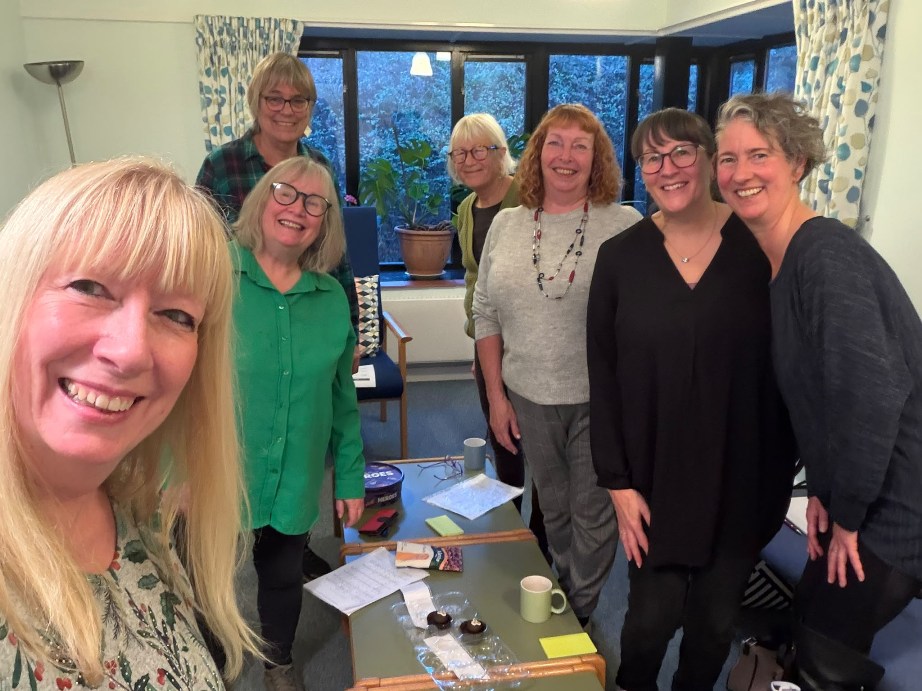 Selfie or it didn't happen!I spent all day Wednesday with the Music Team of Junction 14 chorus in Milton Keynes. I had done a similar training day with them about a decade ago, but there have been a number of personnel changes since then, not least in the musical directorship, so they felt it would be useful to have some training together to cement the current line-up. There comes a point when it’s no longer the same broom, even if you only change the handle or the head at any one time.
The initial remit was to build the day around two of the standard themes I offer: The Two-Dimensional Music Team: Functions and Roles and The Musical Music Team. As we got deeper into the planning, a number of more specific development needs and were identified, so we ended up with a rather more bespoke workshop. A late-night conversation in the afterglow at LABBS Convention was particularly valuable for getting an insight into how the team has been operating to date and how they would like that to develop.
We started the day with a singing exercise, and interspersed our work on other things with others throughout the day, before spending the final session on entirely musical activities. This was driven by the theme of the Musical Music Team, but on reflection I would probably have programmed at least some of the short bouts of singing in anyway, as I don’t believe in a music team being together without making some actual music. Singing together offers an experiential substrate that underpins and informs all the more administrative, educational and pastoral functions of the team; breathing together and tuning to each other sets up a fundamental trust and collaborative atmosphere.
With this in mind, we spent some time exploring how to clear out time in music team meetings for practical musicking, as it is all too easy for committee work to balloon into all the time available and then some. A key part of this was to programme the musicking first, to make sure it happens. It’s all too easy to treat workshopping new music or trialling exercises as nice-to-haves that you earn by doing all the dull admin first, like not being allowed your dessert until you’ve eaten your greens. But the point of the music team is to support the musical and educational development of the chorus, so putting the practical skills and strategies to achieve this front and centre deserves to be prioritised. Just because it is more pleasurable than admin doesn’t make it less important.
The team knew that they wanted to spend less time discussing things and more time singing, and they themselves identified a number of things they could do to keep the committee work moving more efficiently, much of which involved advance preparation in developing the agenda and making sure that all the information needed to make good decisions was available ahead of time. We also talked about having clarity of purpose in each agenda item: was the point to generate ideas together, to make policy decisions, or to assign concrete actions? A lot of inefficiencies can result from getting these tangled up, especially in situations where there are multiple possible right answers.
Clarity was also something we talked about with regard to rehearsal activities, to facilitate momentum on chorus night. In particular we wanted to develop protocols to collect insights from the team as supplementary ears for the director without establishing a norm for the chorus as a whole of making observations from the risers, which had been tending to slow the rehearsal process up.
A key distinction here was between the Urgent and the merely Important. Something is urgent if you can’t continue without addressing it, e.g. ‘what song are we singing?’ or ‘Mary looks poorly, can we sit her down?’ Things like identifying wrong notes, or clarifying breath points are important, and the MD wants to know about them, but not necessarily at the moment they immediately arise. The protocol we developed was: only interrupt the rehearsal process for Urgent issues.
Of course, this means that you need also to have ways of capturing and collecting the Important insights from the team and indeed the rest of the singers. One way is regularly to ask music team members to come out to the front to listen. We did some considerable work on things to listen for, and how to give feedback; this discussion led on the identifying the ideal length of passage to sing for this kind of in-house coaching (at least a couple of lines, no more than a page), and the implications for preparing convenient entry points throughout a song. Another way is to ask all chorus members to let their section leaders know of anything they want to raise, so it can get planned in to future rehearsals, along with the SL’s own observations.
For things that are not absolutely urgent, but could usefully be looked at sooner rather than later, we talked about the protocol of the section huddle. Any SL can ask for this, and the director can make space for it at a convenient point in the process within the next few minutes. This is useful for things like fixing a small error before it gets more practised in, or clearing up an area of confusion to allow the general rehearsal flow to be more effective. But it should probably not happen every week, and anything that is going to take more than 2 minutes to sort should get programmed in for dedicated section time.
We had spent time first thing analysing the strengths and passions of the team members, and this paid off repeatedly as the day progressed. In particular, it flushed out that whilst there is a lot of common ground in all their personal crusades, there are some differences in emphasis, particularly as to whether it is having fun or seeing improvements that primarily motivate them. It was useful then to spot as we explored our various practical themes where we found things that would serve both imperatives at once. Exercises that develop skill through silly games, developing rehearsal vocabulary to celebrate success, and maximising the singing time will all promote both agendas. Above all, creating opportunities to achieve things sends everyone home feeling good about themselves.


You may also like ...
|
Node 2,939
Weight = 4. Common link to https://www.junction14.org/ (2), Two tags in common [87 posts have this] Coaching, Learning (2) 
|
Node 3,031
Weight = 3. Three tags in common [4 posts have this] Coaching, Learning, Music Teams (3) 
|
Node 1,998
Weight = 3. Links to Music-Team Training at Junction 14 (2), One tag in common [502 posts have this] Music Teams (1) 
|
Node 1,875
Weight = 3. Three tags in common [4 posts have this] Coaching, Learning, Music Teams (3) 
|
...found this helpful?
I provide this content free of charge, because I like to be helpful. If you have found it useful, you may wish to make a donation to the causes I support to say thank you.
Archive by date
- 2026 (32 posts)
- 2025 (24 posts)
- 2024 (46 posts)
- 2023 (51 posts)
- 2022 (51 posts)
- 2021 (58 posts)
- 2020 (80 posts)
- 2019 (63 posts)
- 2018 (76 posts)
- 2017 (84 posts)
- 2016 (85 posts)
- 2015 (88 posts)
- 2014 (92 posts)
- 2013 (97 posts)
- 2012 (127 posts)
- 2011 (120 posts)
- 2010 (117 posts)
- 2009 (154 posts)
- 2008 (10 posts)
