
Plus de Musicologie en Paris

Quick plug for this publication from members of CReIMQuick plug for this publication from members of CReIMHaving unloaded my initial impressions of the experience of attending a conference in my second language for the first time, I also wanted to have a brief mull over some of the things I found myself taking notes about from other people’s papers. Feminist musicology is a relatively recent addition to the landscape of francophone musicology, I gather, and is still getting itself established.

(Whereas in anglophone musicology, it was fully respectable by the mid-1990s. This means that when you say anything particularly feminist these days, some helpful soul can breezily dismiss your point with the assertion that we did all this 20 years ago so there can really be nothing left to complain about. I am thinking of a particular exchange from a couple of months ago when I write that, but in a fit of discretion I am not going to say who it was between. Just because I am angry with someone doesn’t mean I have to be gratuitously rude about them online.)

The Intervention and Enforcement Cycles, Part 3

Having outlined the basic framework, and analysed some of our commonest errors, it is time to finish with some extra advice on how to use the Intervention and Enforcement Cycles to best effect.

  • Positive framing: “Do this!”

    Don’t breathe at the end of this phrase
    Join these two phrases together

    These are identical in intent as interventions (or, indeed, enforcements), but the second is a far easier instruction to follow. Likewise:

    Less volume in this section
    More hushed here

    If we always frame our instructions in terms of things to add to the performance, rather than things to take away, it keeps people focused on what you are achieving together. This means that not only is it more emotionally satisfying (succeeding at something feels better than merely not failing at something), but it gives your singers more control over their developing skills to think about them in terms of actions they can do rather than mistakes to avoid.

The Intervention and Enforcement Cycles, Part 2

intervention

Having looked in my post last week about what the Intervention and Enforcement Cycles are and how they work, it’s time to have a look at how to use them more efficiently and effectively. So, here are some of the commonest forms of inefficiency in rehearsal that dilute our effectiveness.

Musicologie en Paris

Université Paris 8Université Paris 8

I’m going to interrupt my series on rehearsal techniques to stop and boggle for a bit about my trip last week to France for my first ever experience of a conference conducted mostly in my second language. I had been invited as one of two keynote speakers to a conference entitled Music and Gender: Current State of Research,* and although conference was genuinely international, with speakers from Brazil, Italy, Spain and Greece as well as France, England and Ireland, we were the only two to present in English.

Now, I have read a good deal of French over the years, including some reasonably dense music theory, so I wasn’t entirely unprepared for this. But most of my actual live interactions in the language have been of the ‘two beers and a cheese sandwich’ type, so in other ways this was something of a baptism of fire. I will have some thoughts to share on matters of music and gender arising from the papers and their discussion in due course, but my most immediate response is to want to reflect on what I learned about language, learning and communication from the adventure.

The Intervention and Enforcement Cycles, Part 1

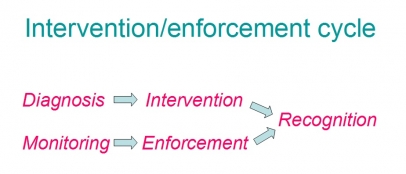
Following on from my post on rehearsal pacing, here at last is the first post about the Intervention and Enforcement Cycles. These describe the two fundamental processes that underlie the process of rehearsing an ensemble, and which can thus be used to analyse the detail of what we do with our choirs and maximise both the efficiency and effectiveness of our work with them.

Today I will outline how they work, and what the main differences are between them. In my next post I will discuss some common inefficiencies whereby directors let effectiveness leak out of their rehearsals. And the third post will give some extra hints and tips for good practice.

So, the two cycles look like this:
intervention

On Rehearsal Pacing

Rubric for rehearsal pacing: using my special 'almost legible' writingRubric for rehearsal pacing: using my special 'almost legible' writing
This is the first of a series of posts about efficient rehearsal techniques, about ways to get maximum bang for your rehearsal buck. The ones that follow are about the Intervention and Enforcement Cycles, which I keep mentioning with a promise to get around to blogging about them one of these days. That day is nearly here, but talking about rehearsal pacing is a useful set-up, so I’m doing this one first.

This diagram gives a usefully quick and dirty way of assessing the pace of a rehearsal by mapping patterns of activity on the choir’s experience:

So, long periods of talking will slow down the pace of rehearsal, and if combined with short bursts of singing, will send your singers home bored. Short periods of talking, conversely, give less opportunity for the singers to disengage. Combined with short bursts of singing, you get a fast-paced rehearsal, or with longer spans of musical time it becomes more relaxing.

Choir Discipline, Conductor Discipline

I was working with a relatively novice conductor recently who was grappling with the challenge of how to command the attention of the choir. Anyone who has spent time either teaching or running rehearsals will sympathise, indeed will probably have had recurring anxiety dreams about failing to do so. (Please tell me I’m not the only one who has these!)

So we started out looking at various specific techniques you can use to command a room (more of which below), but very soon stumbled over a fundamental point that underpins their success or failure. It relates to the truism that you can’t control anyone else’s behaviour; all you can do is create an environment in which they will choose to control their own in the ways you desire.

How to build a warm-up

I wrote these notes for a session at Magenta’s retreat back in September in which a team of seven choir members prepared and led one element each of the warm-up. This was part of our general principle of handing round leadership in various activities as a way to develop the choir as a whole through experiencing different people’s perspectives, and the individuals within it through the act of leading. It was also intended as a way to raise everyone’s awareness of the elements of warming up and thus increase our sense of purpose as we engage with it each week.

As so often happens when I’ve written some notes for Magenta, I thought: you know, other people might find these useful too. Let’s publish this as a blog post. So here you go.

...found this helpful?

I provide this content free of charge, because I like to be helpful. If you have found it useful, you may wish to make a donation to the causes I support to say thank you.


Archive by date

Syndicate content