

On the Fragmentation of Attention

I have often thought that when people complain of being short of time, it is more often that they are short of brain space. If you do an audit of every minute in your day, there are often plenty of minutes that are ‘unproductive’ if regarded from the outside. But, from the inside, you can’t make use of those minutes for anything very much because it just takes too much energy to upload something productive into your head for a brief time, and then - just when you’ve got going - dump it out again for something else.

This is of course that standard wisdom about why multitasking is inefficient - there are frictional costs of attention involved in every switch, so switch often enough and you get nothing done. Multitasking still has its place, I’d say, but only with routine tasks that you have at the tip of your brain anyway. I quite like the definition that multitasking is a technique for avoiding several dull tasks by doing them all at once.

Adrenaline and Tempo: Taking Control

I recently had a question from a director that struck me as one of those that I’m sure a lot of us grapple with on occasion. So I gave her some specific advice for the performance she was preparing for in the immediate future, but said I’d give it a think and blog in more detail about other things to consider after the big gig.

This was her question:

When I'm directing, even if in my head it's painfully slow.... It's much faster! I know it's linked to my nerves/adrenaline of competition but recently realised it happens a lot

My immediate advice was twofold:

Getting into the Detail with Cleeve Harmony

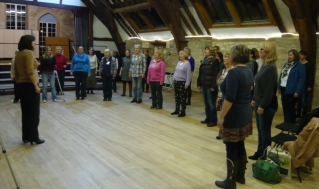
Cleeve Nov 2015As I was about to leave after my coaching session with Cleeve Harmony last Wednesday, their director, Donna, asked, ‘So what’s the blog going to be about?’ She thereby drew my attention to the process of reflection that goes into that decision. When we’ve only just stopped making music, all the multifarious things we have done together are all jumbled up in my head: vocal things, performance things, conducting things, musical things. It takes some time thinking back over it all to discover which bits are going to stand out as the bits I feel like writing about.

On this occasion, I awoke the next morning to the realisation that the part of the session that had stayed with me most vividly was an intensive 25 minutes or so focused on sorting out a sequence of just 7 chords that had never quite settled into place. You know the kind of passage - one you’ve got it near enough right that you get away with it in performance, but not right enough to feel happy with it.

LABBS Convention 2015

bournemouthBournemouth at the end of October/start of November was astonishingly warm and balmy - you can see why it is a traditional British holiday town. Of course I wasted nearly all the great weather huddled inside the Bournemouth International Centre listening to people sing, but that’s how my sense of priorities works. Still, I was grateful not to find myself as windblown as you get sometimes at the Ladies Association of British Barbershop Singers conventions.

This was the second year I was attending without judging duties, and I can see that I’ll be saying, ‘No I’m not a judge any more,’ to people asking me about my weekend for years to come. (I mention this here in an attempt to hasten the process of people taking that on board.) I did have a new ‘official’ duty this year, though; in my role as LABBS Chorus Director Development Specialist I ran a Fringe session on ‘What Do You Want From Your Chorus Director, and What Do They Want From You?’ on the Friday afternoon.

Soapbox: On Bad Faith

soapboxI have been thinking about Joanna Russ’s classic of literary criticism How to Suppress Women’s Writing (1983) a fair bit recently, mostly in response to a clickbaity piece in The Spectator back in September that claimed that the reason that the work of female composers is not featured more extensively in educational syllabuses is because the various examples the author could think of are all crap. I paraphrase here, of course, but not by much. I’m not going to link to the article, because frankly I don’t want it to get any more traffic than it has already got, but I will point you to a nice response to it, and to my letter to The Spectator. Between them you should get the picture.

(I did dither about whether to write a response to them at all; part of me felt it was in the category of ‘don’t feed the trolls’. But I also figured that if nobody called bullshit on it, then future historical musicologists might conclude that such views went unchallenged in 2015. And if it needed doing, I was as good a person as any to do it.)

On the Usefulness of Humming

After one of my ‘Make Your Nerves Work For You’ classes at BinG! Harmony College, one of the participants came up and remarked that I had mentioned humming in several different contexts, and could I give her a list of the different uses it has. My reply was: that sounds like a follow-up blog post. So here it is. A little way after the event, but there’s been quite a lot of stuff going on just lately that I wanted to blog about as it happened.

I suppose I should start with humming as a form of singing. As an activity to use in the warm-up, it is a nice gentle (and safe) way to start phonation and get the voice moving - I guess it would be possible to hum with voice-damaging tension if you deliberately tried to, but it’s pretty unlikely to happen by default. And while you’re at it, you can focus on activating the resonant cavities in your head to enhance both the richness and brightness of your sound.

Developing the Director-Chorus Bond with Avon Harmony

And the traditional warm-up shot before I get started...And the traditional warm-up shot before I get started...Last Saturday took me down to work with Avon Harmony in Bristol. I last worked with them back in 2012 when their director, Alex, was relatively new in the role. You could see how much he had worked on his technique in the intervening time, and how he was being rewarded with a much more consistent and resonant sound. We spent much of the day mapping out where the next stages of development are going to lie.

First up, though, was one basic bit of conductorly bad habit that we needed to deal with. Like many directors, Alex was frequently tempted into mouthing the words. I have tried various methods to help directors break this habit over the years, often involving holding things in their mouths. Straws are good, as blowing into a straw is good for the vocal mechanism, so gives a positive benefit in how the director models their bodily set-up as well as inhibiting the habit you’re trying to eliminate.

Surrey Harmony and the Musical Music Team

Rubric for rehearsal pacing: using my special 'almost legible' writingRubric for rehearsal pacing: using my special 'almost legible' writingThursday night saw me doing another session for a chorus’s music team, this time with Surrey Harmony. It was a rather different dynamic from my last session - a similar number of people, but this time the entire team from a single chorus rather than a couple from each of several choruses. What we lost in the opportunity to compare experience between different ensembles we gained in the opportunity to develop mutual understanding and shared working methods within the group.

(As an aside: there is a truism lurking in there about the learning process. What you can learn in any given scenario is to some extent a function of your own needs, beliefs and habits, but it is also a function of who you are learning with.)

...found this helpful?

I provide this content free of charge, because I like to be helpful. If you have found it useful, you may wish to make a donation to the causes I support to say thank you.


Archive by date

Syndicate content